

Agencies say EMF health effects are not consistently replicated because the overall evidence has not met their threshold for a formal health or regulatory conclusion. The phrase describes how consistently studies produce similar results under the agency’s review criteria. It does not prove that every reported effect is false or that every exposure is safe under every condition.
EMF Guru takes a calm, measurement-first approach. We do not treat every positive study as proof of harm, and we do not treat every agency statement as proof of safety. We look at what was measured, how the exposure was created, what question the agency was answering, and which practical changes can be verified with before-and-after readings.
What does “not consistently replicated” actually mean?
“Not consistently replicated” means that later studies did not reproduce an earlier finding often enough, or closely enough, to satisfy the reviewer. That matters, but the phrase can cover several situations: a false positive, a true null result, different endpoints, different exposure conditions, or a mixed literature with both positive and null findings.
Replication is one of science’s essential checks. A result that disappears under a genuinely equivalent repeat study deserves less confidence. The difficulty is deciding whether the later study tested the same biological question under sufficiently similar conditions.
This distinction is easy to miss in short public summaries. The FDA says that the weight of scientific evidence has not linked cell phone RF radiation with health problems. That is a clear statement of the agency’s conclusion. It does not tell the reader that every study used the same exposure system or measured the same outcome.
When you see the word “replicated,” ask four questions:
- Was the same exposure pattern reproduced?
- Was the same biological endpoint measured?
- Was the timing of exposure and measurement comparable?
- Was the follow-up study large and well controlled enough to answer the same question?
Is “no established link” the same as “proven safe”?
No. “No established link” means the evidence an agency prioritizes has not met its threshold for a formal causal or regulatory conclusion. “Proven safe” is a much broader claim about all people, endpoints, exposure patterns, and timeframes. Responsible agency language usually makes the first claim, not the second.
The FDA states that “the weight of scientific evidence has not linked cell phone radio frequency radiation with any health problems.” The same page says scientific evidence does not show a danger to users, including children and teenagers. Those statements should be quoted accurately and understood in context.
An agency can reach that conclusion while acknowledging uncertainty elsewhere in the evidence base. Some studies may report biological changes, animal findings, or possible mechanisms without establishing a human disease outcome. Regulators may judge those findings preliminary, inconsistent, not directly applicable to people, or outside the endpoints used to set current limits.
A careful translation is:
- Agency conclusion: The evidence has not established a health problem under the agency’s review criteria.
- Overbroad interpretation: RF exposure has been proven safe in every real-world situation.
- EMF Guru reading: The first statement does not establish the second, so proportionate precaution remains a personal planning option.
Why can RF studies produce different results?
RF studies can produce different results because the label “RF exposure” covers many technically different conditions. Frequency, modulation, pulsing, duty cycle, peak and average intensity, antenna geometry, distance, exposure duration, temperature control, biological model, age, sex, and measurement timing can all affect what a study is actually testing.

The National Toxicology Program’s cell phone RF studies are a useful example of why exposure details matter. They used whole-body exposures in rats and mice with 2G and 3G signal modulations. Those experiments can inform the evidence discussion, but they are not a direct copy of how one person uses a modern phone.
A later study that changes the signal, dose pattern, biological model, or endpoint may still be valuable. It may not be a close replication of the original claim. That does not rescue every positive finding, and it does not invalidate every null finding. It means the comparison should be made at the level of methods, not only headlines.
The practical question is not, “Which side has a study?” Both sides usually do. The better question is, “How closely did the studies match, how well were they controlled, and how much confidence should this particular result receive?”
What question are regulators trying to answer?
Regulators are primarily deciding whether evidence supports exposure limits, product requirements, warnings, or other public policy. That is a different task from helping one household decide whether a router should sit beside a bed. Legal compliance and precautionary planning use different decision thresholds because they answer different questions.
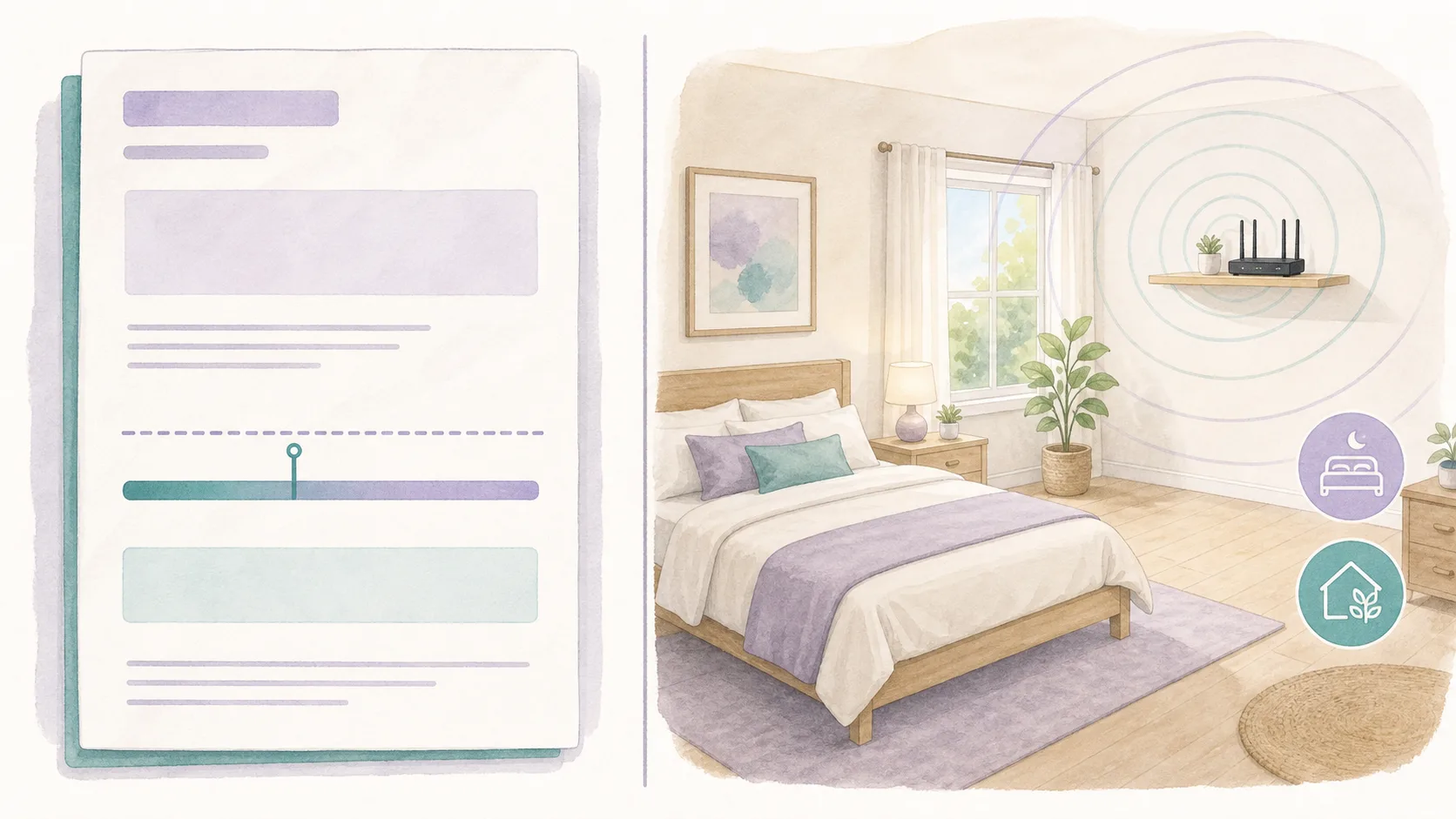
In the United States, the FCC’s radiofrequency exposure limits are codified in 47 CFR section 1.1310. Device exposure is often discussed through Specific Absorption Rate, while transmitter environments may be evaluated using field strength or power density. These are compliance tools with defined assumptions and purposes.
Our Field Note on FCC limits versus precautionary guidelines explains why a legal limit and a precautionary planning target can use different numbers without being interchangeable. Exceeding a precautionary target does not prove harm or a legal violation. Meeting a legal limit does not require a homeowner to place every wireless source as close as possible.
Compliance answers one question. Practical exposure reduction answers another.
Different regulators can also reach different conclusions from the same evidence base. Our Field Note on how three European governments acted on precaution anyway sets out what France, Cyprus and Belgium each wrote into their own rules for young children.
Does study funding affect how evidence should be read?
Funding can be associated with study outcomes, so it belongs in a transparent evidence review. It should not be used as a shortcut for accepting or dismissing a result. Study design, exposure methods, analysis, disclosure, and reproducibility still need to be examined on their own merits.
A 2007 systematic review by Huss and colleagues examined 59 controlled RF exposure studies. Twelve were funded exclusively by the telecommunications industry, 11 by public agencies or charities, 14 had mixed funding, and 22 did not report a funding source. Industry-funded studies were less likely to report a statistically significant result than publicly or charitably funded studies.
The authors did not prove that one funding category always produces the correct answer. They concluded that sponsorship should be considered when interpreting RF research. That is the defensible takeaway.
Asking who funded a study is ordinary diligence, not an accusation. The goal is transparent disclosure and fair evidence weighting, not conspiracy language.
What evidence keeps the question open?
The question remains open because respected institutions have not all reduced the evidence to a universal safety claim. IARC classified radiofrequency electromagnetic fields as possibly carcinogenic to humans in 2011, and the NTP later reported animal findings that warrant careful interpretation. Neither source proves human harm from ordinary device use.
The International Agency for Research on Cancer classified RF electromagnetic fields as Group 2B, possibly carcinogenic to humans. Group 2B is an uncertainty-preserving category. It does not mean RF was shown to cause cancer in people, and it does not mean the question received an all-clear.
The NTP reported clear evidence of malignant schwannomas in the hearts of exposed male rats and some evidence of malignant gliomas in their brains under its study conditions. These were animal findings from a specific exposure design, not proof of a human outcome. They are relevant because they complicate the claim that there is no evidence worth considering.
The most accurate summary is not “proven dangerous” or “proven safe.” It is that agencies and research programs weigh a mixed evidence base through different roles and criteria. That is precisely where careful language and proportionate precaution matter.
How should you read an agency statement about EMF?
Read the exact claim, identify the endpoint and exposure assumptions behind it, and separate the agency’s regulatory conclusion from broader claims the sentence does not make. Then ask what low-cost choices are available in your own environment. This approach respects agency evidence without turning a narrow conclusion into a universal guarantee.
Use this four-step check:
- Quote the statement accurately. Do not replace “no established link” with either “proven safe” or “the agency is lying.”
- Identify the decision threshold. Ask what evidence would be required for the agency to change a limit or issue a warning.
- Inspect the scope. Look for the exposure type, dose metric, endpoint, population, and timeframe.
- Return to measurable choices. Decide whether distance, timing, source placement, or wiring can reduce exposure without creating a larger problem.
This method keeps the discussion grounded. It leaves room for both genuine null results and credible positive findings, and it avoids making a medical conclusion from a regulatory summary.
What does this mean for your home?
It means you can use wireless technology without treating the scientific debate as an all-or-nothing choice. Start with the places where exposure is close, continuous, or unnecessary. Add distance, reduce unneeded transmission, use wired connections where practical, and measure before and after important changes so the result is visible.
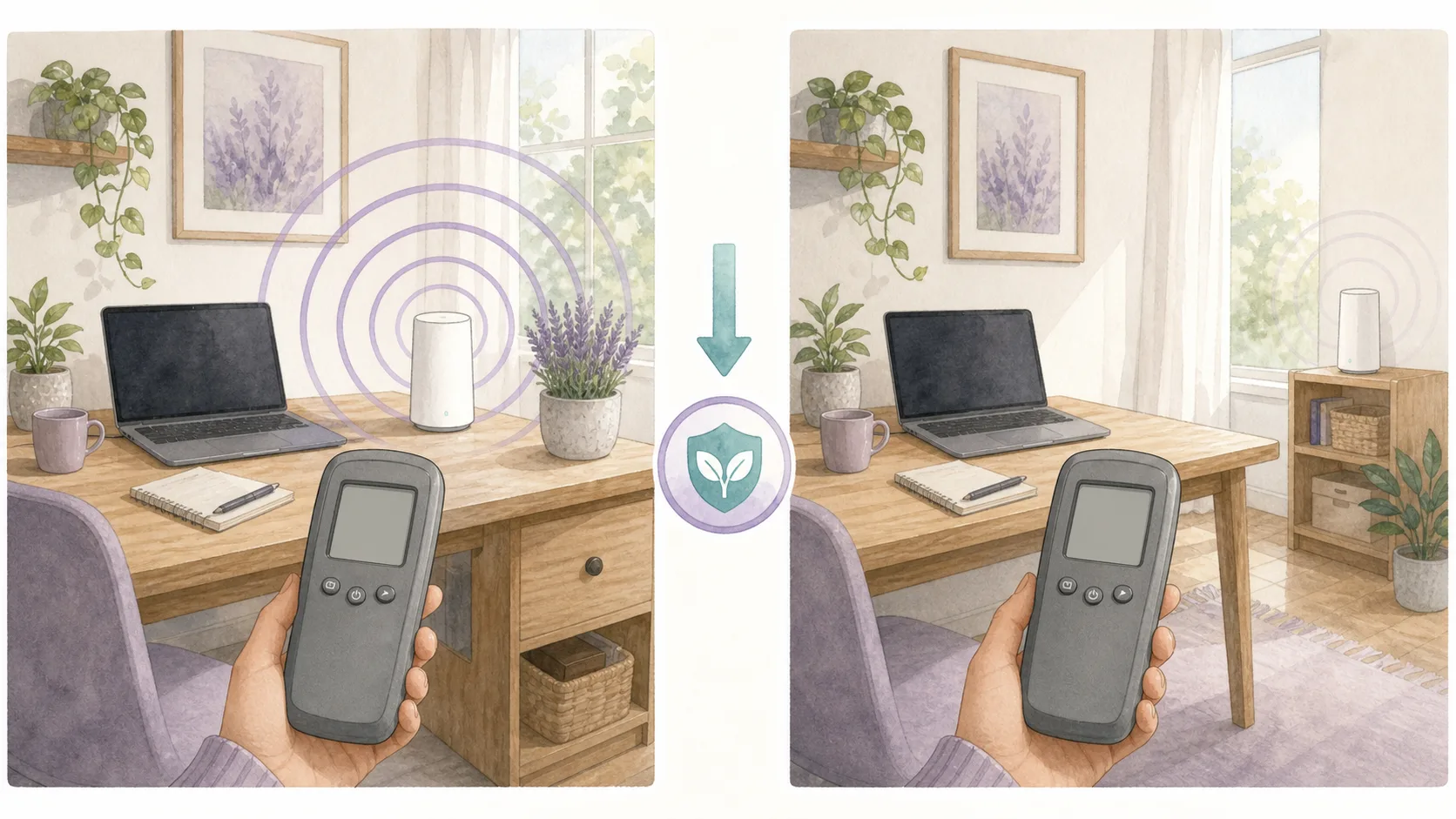
For example, a router can often move away from a bed or desk. A phone can charge across the room instead of beside the pillow. A stationary computer can use wired technology when that fits the household. Features that are not being used can be turned off.
Measurement keeps these choices proportional. EMF testing can replace guessing by showing which source matters most and whether a change reduced the field at the place you care about. A home assessment may consider four types of EMF, not RF alone.
If you are new to the topic, start with What Is EMF? For a broader practical plan, see How to Reduce EMF Exposure Without Going Off Grid.
Precaution is not panic. It is proportional action under uncertainty.
What are readers asking about EMF replication claims?
Readers usually want to know whether failed replication disproves an effect, whether agency reassurance equals proof of safety, why studies conflict, and what to do at home. The short answers preserve scientific uncertainty while returning to practical choices that can be made without fear or medical claims.
Does “not consistently replicated” mean an EMF effect was disproven?
Not necessarily. A close, well-controlled failure to reproduce a result can reduce confidence in the original finding. The phrase can also describe studies that used different exposure conditions, endpoints, or timing. The right response is to compare methods and results, not assume that every failed replication proves no effect exists.
If agencies say there is no established link, is EMF proven safe?
No. “No established link” means the reviewed evidence has not met the agency’s threshold for a formal causal or regulatory conclusion. It does not establish universal safety across every person, endpoint, exposure pattern, and timeframe. It also does not prove harm. The accurate position preserves both limits.
Why do EMF studies get different results?
RF studies can differ in frequency, modulation, pulsing, intensity, dose averaging, distance, antenna geometry, exposure duration, biological model, and the endpoint measured. Those differences can change the question being tested. Some conflicting results reflect genuine null findings, while others may reflect exposure or method differences.
Is EMF Guru saying agencies are dishonest?
No. Agency statements should be quoted accurately and evaluated within their regulatory role. EMF Guru’s point is that phrases such as “no established link” are narrower than a universal safety guarantee. Evidence thresholds, study design, funding transparency, and practical household choices can be discussed without accusing an agency of dishonesty.
What practical EMF steps can I take at home?
Begin with low-cost changes in the places where people spend the most time. Add distance from transmitters, move devices away from beds, use wired connections for stationary equipment, and turn off wireless features that are not needed. Measure before and after meaningful changes so you can verify whether they helped.
What is the bottom line?
Agency phrases such as “not consistently replicated” and “no established link” describe evidence thresholds and regulatory judgments. They do not prove that every reported effect is real, and they do not guarantee universal safety. Use technology, read claims carefully, reduce avoidable exposure where practical, and measure when the question matters.
When a measured check beats the debate.
The research argument about whether effects consistently replicate will not tell you what is actually in your bedroom, nursery, or workspace. A measurement will. A professional EMF assessment can help when:
- You have read conflicting studies and want to know what your own home actually measures.
- Agency guidance says one thing, and you want the real numbers for the rooms you use most.
- You are weighing a device, a move, or a mitigation product and want before-and-after readings.
- Several possible sources overlap (Wi-Fi, wireless devices, home wiring, a smart meter, nearby infrastructure) and you are not sure which one matters.
- You want a room-by-room priority list instead of a headline.
EMF Guru provides measurement-first consultations for homes, bedrooms, nurseries, and workspaces in the greater Portland area. We measure first, identify the sources that matter most, and recommend realistic changes. A consultation is environmental education and planning, not medical diagnosis or treatment. Start with the EMF testing vs guessing overview or schedule an EMF consultation.
Which sources support this Field Note?
This Field Note uses primary agency, regulatory, and research sources for the claims that carry the most weight. The FDA provides the quoted agency position, eCFR provides the legal exposure-limit reference, and IARC, NTP, and the Huss review provide carefully limited context for uncertainty and evidence weighting.
- U.S. Food and Drug Administration, Cell Phones
- International Agency for Research on Cancer, IARC classifies radiofrequency electromagnetic fields as possibly carcinogenic to humans
- National Toxicology Program, Cell Phone Radio Frequency Radiation
- Huss et al., Source of Funding and Results of Studies of Health Effects of Mobile Phone Use
- Electronic Code of Federal Regulations, 47 CFR section 1.1310