
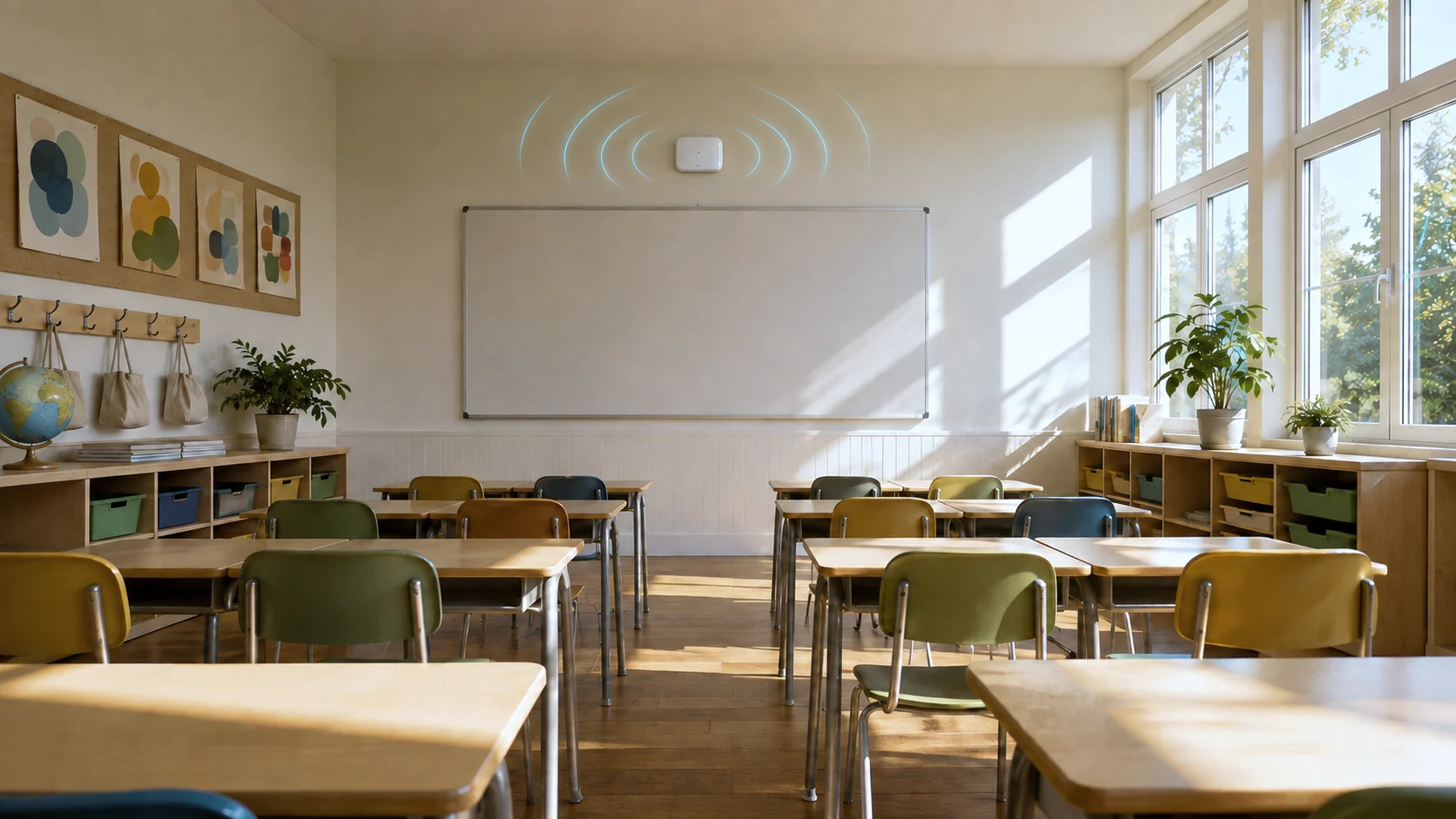
Three European governments have written wireless protections for young children into their rules, and each one reached for a different lever. France legislated about rooms and equipment, barring fixed wireless access points from the spaces used by children under three. Cyprus acted through its own Ministry of Education, switching Wi-Fi off in every public kindergarten by circular in 2017. Belgium went after the product and the way it is sold, prohibiting phones designed for under-sevens.
What France wrote into law in 2015.
The instrument is the loi Abeille, LOI n° 2015-136 of 9 February 2015, at Article 7, and it works at two levels of precision.
Article 7 I is the firmer of the two. It prohibits installing fixed terminal equipment fitted with wireless internet access in the spaces dedicated to the reception, rest and activities of children under three years old, in nurseries and similar childcare establishments. Those are the rooms where the youngest children spend their day, and the law keeps fixed Wi-Fi installations out of them.
Article 7 II reaches primary school classrooms with a different device. Wireless access on equipment installed after the law was published must be deactivated when it is not being used for digital teaching activities. The default is off, the expected state during a lesson is on, and equipment already in place before that date is not covered.
France drew the scope deliberately, and the government is precise about where it stops. The Ministry of Education’s implementation guidance on Wi-Fi in schools, version 1.0, published in May 2015, states plainly: « Le Wi-Fi peut être installé dans les EPLE et les écoles. » Wi-Fi may be installed in secondary schools and in schools. The same guidance records that the restriction reaches establishments listed in one chapter of the Public Health Code, and that écoles maternelles are not among them. The protection is aimed at the under-three settings and at the classroom default, and the guidance says so in terms.
One word is worth keeping in French. The covered settings are crèches, jardins d’enfants and haltes-garderies. A jardin d’enfants is a distinct French childcare establishment type, not an English kindergarten and not an école maternelle, so the rule reads most accurately in the vocabulary the law itself uses.
Cyprus switched its public kindergartens off by ministerial decision.
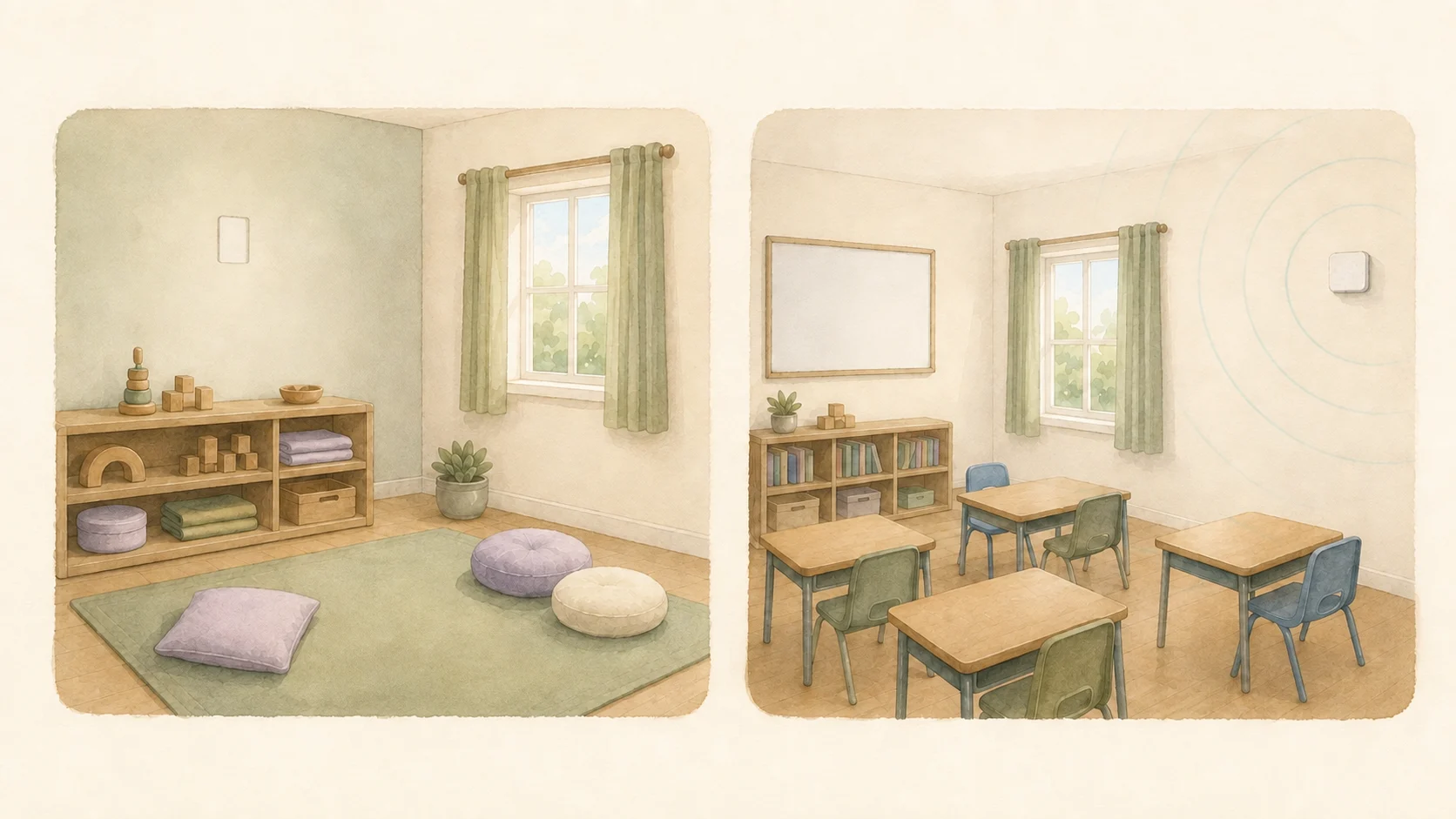
Cyprus reached a comparable result by a different route, and faster. The measure is a Ministry of Education circular, reference 16.08.04/3 of 1 August 2017, addressed to the directors of kindergartens and primary schools. It is administrative direction rather than legislation, which meant the Ministry could act on its own timetable, and it did.
The Greek verbs mark two levels of force inside the one document. For kindergartens the Ministry writes that it has taken the decision that Wi-Fi be switched off in all public kindergartens of Cyprus. For primary schools the Ministry writes that it recommends. The kindergarten sentence is the firmest instruction in this article, and it applies across the whole public network at once.

Cyprus applied the precautionary principle even where the readings were low.
The circular opens by reporting measurements, and this is the part most worth knowing. The Ministry of Health, by letter of 10 March 2016, forwarded readings taken by the Department of Electronic Communications concerning Wi-Fi levels in public secondary schools. The conclusion was unambiguous: the levels are far below the accepted national exposure limits, and consequently student exposure to them «θεωρείται ως εντελώς ακίνδυνη για την υγεία τους», is considered entirely harmless to their health.
The Ministry switched the kindergartens off all the same. The stated reason is not a health finding but a policy choice: the Ministry of Health reserves the right, in light of European developments, to revise the national limits and adopt stricter criteria, and the Precautionary Principle should be applied to primary and pre-primary pupils on that basis. Worth noticing too that the measurements were taken in secondary schools while the measures apply to younger children. This is a government choosing a margin over its own reassuring numbers, which is the clearest example in this article of precaution written into everyday practice.
What the Cyprus circular allows schools to do.
The circular is permissive as well as protective, and the two halves belong together.
The recommendation for primary schools is that Wi-Fi use be limited to the Principal’s office, the Secretary’s office and the Teaching Staff room, for administrative purposes. More firmly, the Ministry states it does not intend to proceed with installing Wi-Fi access points in primary classrooms until new European standards emerge.
The same paragraph then opens a door. Where a school judges it necessary because of curricular or other programmes and activities, the circular expressly permits teachers and students to use the wireless network, on two conditions: the access points must remain inactive when they are not being used in teaching, and the school’s Directorate must first assess whether the programme has something substantial to offer the educational process. Wired internet, the circular records, already reaches every classroom and laboratory, so the teaching goes on either way.
Read next to Article 7 II, that condition is the same regulatory device France chose. Two governments, different legal systems, no coordination between them, both landing on the same rule: the access point is off unless it is being used to teach.
Belgium acts on the product and its marketing.
Belgium pulls a third lever. Two federal Royal Decrees of 30 July 2013 leave buildings alone and reach the product and the way it is sold. Mobile phones specifically designed for children under seven are prohibited from being placed on the market. Advertising that promotes mobile phone use to children under seven is prohibited, and so is advertising aimed at that group in children’s radio and television programmes, on websites, and in children’s magazines or other brochures.
The definitions are the elegant part. The rule is drawn around a product category defined by who it was designed for, and around marketing defined by who it is aimed at. That is how Belgium reaches a specific age group without regulating what families are allowed to own.
Brussels writes an exposure ceiling into regional law.
Belgium’s regions set their own exposure ceilings, and Brussels is the one usually quoted. The current general limit in the Brussels-Capital Region, at the 900 MHz reference frequency, is 9.19 V/m indoors and 14.57 V/m outdoors in publicly accessible zones. The figure of 6 V/m that travels alongside it belongs to a different instrument: a broadcast exception regime, a carve-out for situations where radio and television transmission makes it impossible for telecom operators to meet the norm while maintaining minimum coverage.
The number has moved as the networks have. The 2007 ordinance set 3 V/m. In April 2014 the parliament amended it upward to 6 V/m to allow 4G. The ordinance framing 5G, validated on 2 March 2023, produced the current values. The limit has been raised at every revision.
What is worth knowing is the margin underneath those numbers, and the way it has narrowed. Bruxelles Environnement states that its protection level remains 20.1 times stricter indoors and 8 times stricter outdoors than the international ICNIRP reference. Those are power-density ratios; in volts per metre the same margins are 4.48 and 2.83 times. Measured that way against the 41.2 V/m ICNIRP reference the same page cites, the Brussels ceiling sat 13.73 times below it in 2007 and 6.87 times below it after the 2014 revision, and sits 4.48 times below it indoors today. A region that writes a numeric ceiling into its own law, holds it below the international reference at every revision, and states that comparison on its own regulator’s page, is doing something most places never attempt. For the equivalent comparison in the United States, see FCC limits versus precautionary guidelines.
Three governments, three different legal levers.
The useful thing about these three is that they are not doing the same kind of thing at all. Between them they cover most of the ways a regulator can act. France regulated the premises: which equipment goes in which rooms, and when it has to be off. Cyprus regulated its own ministry’s practice, by administrative instruction rather than statute, which is what let it move in a single document. Belgium regulated the product and its marketing: what may be sold, and to whom it may be advertised.
None of the three tells you what is in your house. All three are worth knowing because they show what a careful regulator does when it decides to act: it names the setting, narrows the scope, and writes down exactly what it is covering. Our Articles and Guidance Links page collects further reading on how measures like these are reported.
Want to know what your own rooms measure?
A foreign regulation cannot tell you what your rooms measure. A measurement can. Consider a measured assessment if any of these describe you:
- You have read about the French or Cypriot rules and want to know what the wireless in your own child’s classroom actually reads.
- Someone shared a foreign rule with you and you would like to know how your own home compares.
- You sit on a parent council or school board weighing a wireless policy and need numbers for your building, not for Brussels.
- Your school moved to wired access and you want to know whether the change did anything measurable.
- You are curious how your rooms compare with a precautionary limit you read about abroad.
EMF Guru provides measurement-first consultations for homes and small workplaces in the greater Portland area. For a question like this one, that means measuring the wireless sources actually present in the rooms your family uses, so the comparison is with your own readings rather than somebody else’s statute. This is educational measurement and interpretation, not a medical or diagnostic service. Wi-Fi router placement covers the changes that tend to matter most, and you can schedule a consultation when you want readings for your own space.
Frequently asked questions about EMF rules in other countries.
What kind of measure is the Cyprus school Wi-Fi rule?
It is a Ministry of Education circular of 1 August 2017, which is administrative direction rather than legislation. Inside it, the kindergarten switch-off is a decision, and the limitation of primary-school use to administrative rooms is a recommendation.
What does Belgium’s rule on children’s mobile phones cover?
It covers the product and its marketing. Belgium prohibits placing on the market phones specifically designed for children under seven, and prohibits advertising that promotes phone use to that age group, including in children’s radio and television programmes, on websites, and in children’s magazines or other brochures.
What is the legal EMF exposure limit in Brussels?
At the 900 MHz reference frequency, 9.19 V/m indoors and 14.57 V/m outdoors in publicly accessible zones. The 6 V/m figure often quoted alongside it belongs to a separate exception regime for situations involving radio and television broadcasting.
Sources referenced for this Field Note.
- LOI n° 2015-136 du 9 février 2015, Article 7, the loi Abeille, quoted from the text adopted by the Assemblée nationale on 29 January 2015. This article quotes the law as adopted.
- Ministère de l’Éducation nationale, Référentiel sur l’usage du Wi-Fi en établissement et école, version 1.0, May 2015.
- Cyprus Ministry of Education, circular αρ. φακ. 16.08.04/3, 1 August 2017, revised.
- SPF Santé publique, Nouvelles règles relatives à la vente de téléphones mobiles, 2014 FAQ on the Royal Decrees of 30 July 2013.
- Bruxelles Environnement, Quelles sont les normes légales d’exposition aux ondes électromagnétiques.
- EMF Guru, Articles and Guidance Links.