
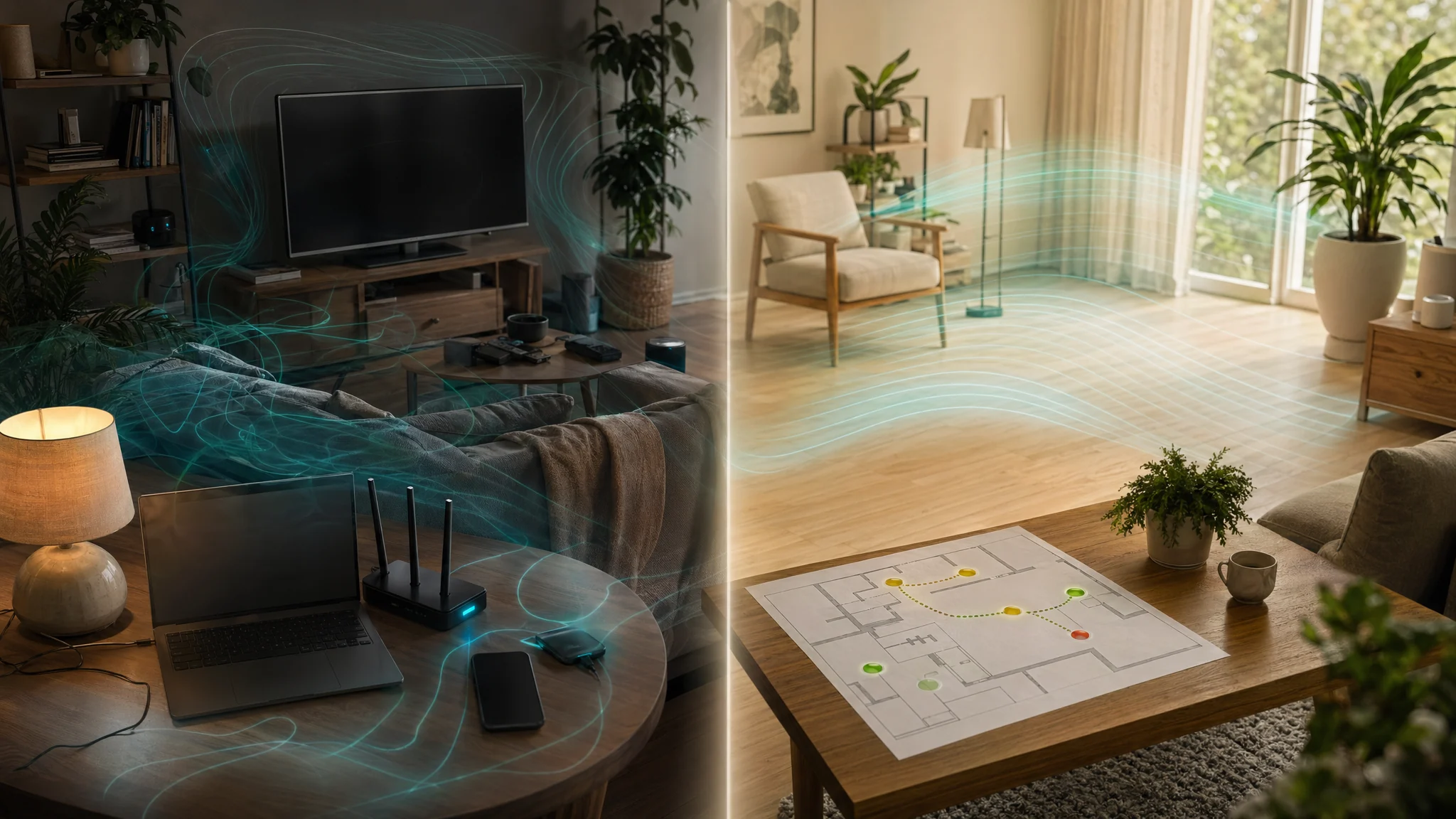
It is easy to guess about EMF. A router is visible, a smart meter is noticeable, and a cell tower may be nearby. But visible sources are not always the most important sources, and the strongest concern in a room may be something hidden in wiring or located on the other side of a wall.
Testing changes the conversation from “I wonder if this is a problem” to “Here is what we measured, where we measured it, and what changed when the likely source was adjusted.” That shift is what keeps EMF work calm and practical.
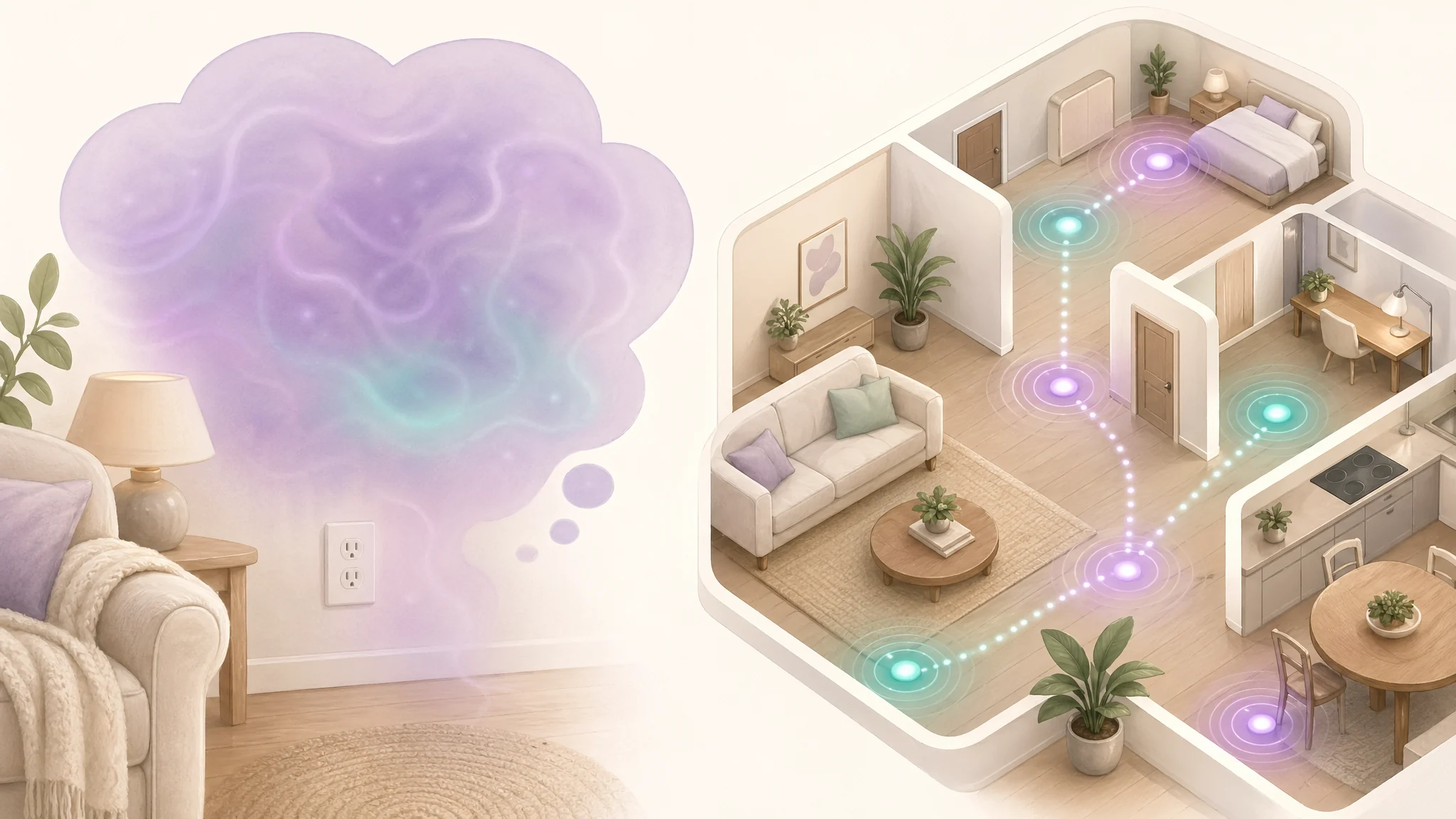
Guessing can lead to the wrong solution.
Guessing often begins with the source that is easiest to see. A homeowner may focus on a router because it has antennas, or on a smart meter because it is mounted outside a bedroom. Those sources may be relevant, but they may not be the main contributor to the readings in the space that matters.
For example, a bedroom concern might turn out to involve a lamp cord and outlet placement rather than RF. A home office concern might involve a power strip under the desk rather than the distant cell tower. A nursery concern might involve equipment behind the wall in a utility area. Without measurement, it is easy to spend time and money on the wrong category.
Product-first decisions can also create false confidence. A filter, shield, canopy, paint, or plug-in device may sound protective, but it can only be evaluated in relation to a measured field type and location. Some products are useful in specific situations. None should be treated as universal answers.
Testing creates priorities.
A measurement-first approach starts with the rooms and positions that matter most: beds, desks, favorite chairs, nurseries, and other high-use locations. Then it asks which field types are present and which sources influence those readings.
The process may include RF measurements near wireless devices, electric-field checks near cords and outlets, magnetic-field mapping near panels or shared walls, and circuit-level review for dirty electricity when appropriate. Each field type needs the right meter and interpretation. One number cannot summarize the whole home.
Priorities become clearer when readings are compared. Is the bed area different from the center of the room? Does the reading change when a router is moved? Is the field strongest near one wall? Does it change when a major appliance cycles or when a circuit is off? Those comparisons are often more valuable than a single peak value.
Testing also verifies results.
Testing is not only for finding sources. It is also for confirming whether a change worked. If you move a router, add Ethernet, reroute cords, unplug a charger, or correct a wiring issue, the relevant reading should be checked again. That feedback prevents both under-reaction and over-reaction.
Verification is especially important when a solution is expensive or disruptive. Before installing shielding, replacing equipment, or making electrical changes, it is worth confirming the source, pathway, and field type. After the change, retesting helps show whether the intended exposure was actually reduced.
What good EMF testing looks like.
- It is location-specific. Readings are taken where people actually spend time.
- It separates field types. RF, electric fields, magnetic fields, and dirty electricity are not blended into one vague result.
- It tests source behavior. Devices, circuits, and locations are compared when practical.
- It explains limits. Measurements can identify environmental conditions, but they do not diagnose health issues.
- It leads to practical steps. The outcome should be a priority list, not fear.
When professional testing helps.
Professional testing is useful when the concern involves bedrooms, nurseries, home offices, utility equipment, wiring, smart meters, nearby infrastructure, apartments, or any situation where several sources overlap. It is also helpful before investing in mitigation products.
If you are not ready for a consultation, start by observing patterns. Where is the concern? What devices are nearby? What is on the other side of the wall? What can be moved or turned off easily? That information makes any future testing more efficient.
For a category overview, see The Four Types of EMF We Measure in Homes. For service details, visit EMF Guru consulting.
A measured decision workflow.
- Name the concern. Identify the room, source, or situation that prompted the question.
- Choose the field type. Decide whether the question is RF, electric fields, magnetic fields, dirty electricity, or a combination.
- Measure the high-use location. Start where people sleep, work, or spend repeated time.
- Test likely sources. Move, unplug, switch, or compare sources one at a time when practical.
- Verify the change. Measure again before deciding the issue is solved.
This workflow is slower than guessing, but it usually saves time overall because each step narrows the question. It also makes recommendations easier to explain and easier to repeat later.
How testing prevents unnecessary work.
Testing can also show when a suspected source is not the priority. That can be just as valuable as finding a problem. If a smart meter, router, or device is not meaningfully influencing the high-use area, the homeowner can focus elsewhere instead of spending money on an assumption.
This is especially useful in apartments and dense neighborhoods, where sources from neighboring units may overlap with sources inside the home. Measurement helps show what is actually controllable.
Note: EMF Guru provides education and environmental measurement services, not medical diagnosis or treatment. If you have health concerns, work with a qualified healthcare professional. Measurements can help clarify environmental sources and practical exposure-reduction options.