
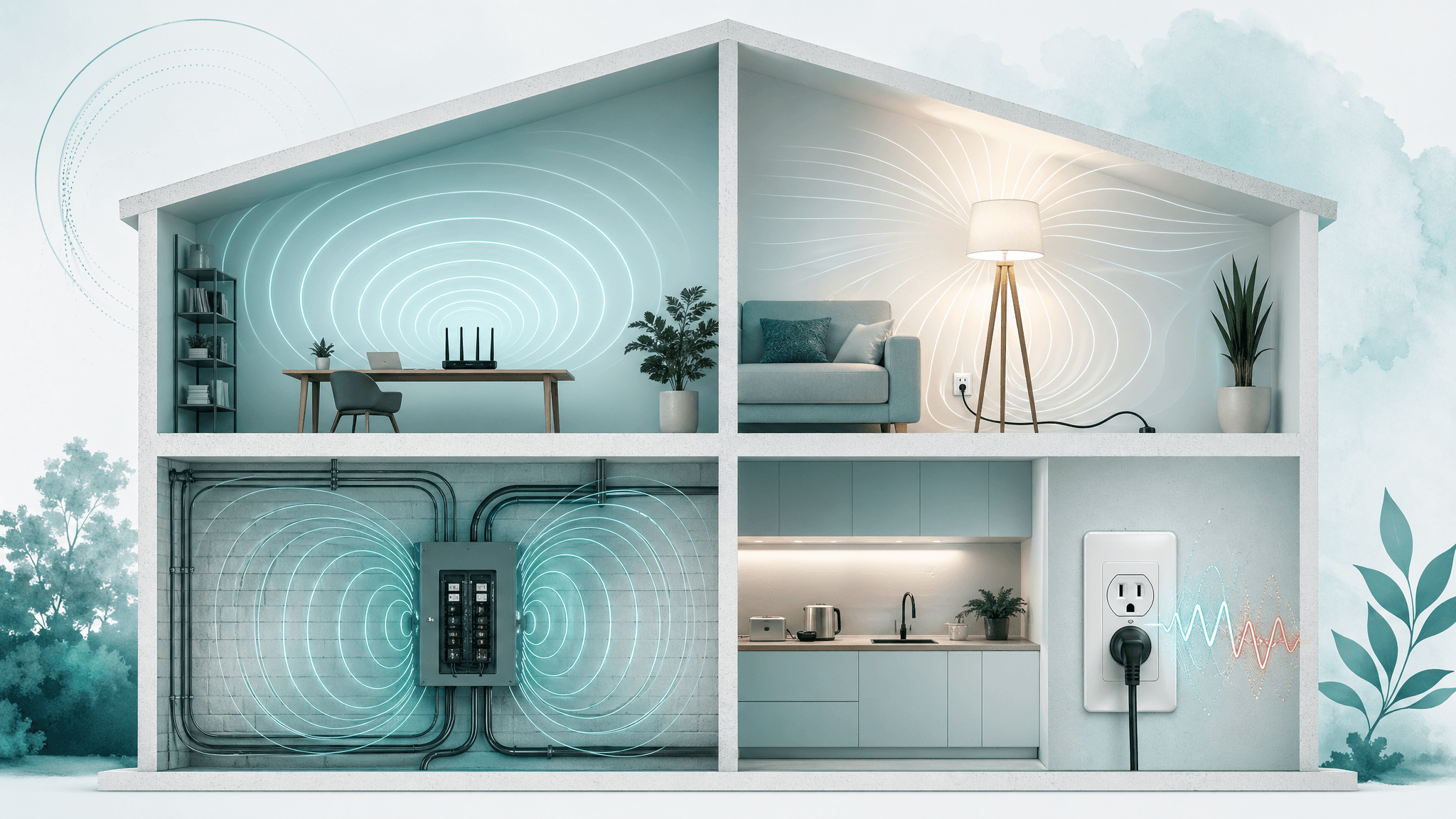
A good home EMF assessment does not rely on one meter or one reading. “EMF” includes several different field types, and each one behaves differently in a building. Understanding the categories helps homeowners make better decisions and avoid buying products before they know what problem they are trying to solve.
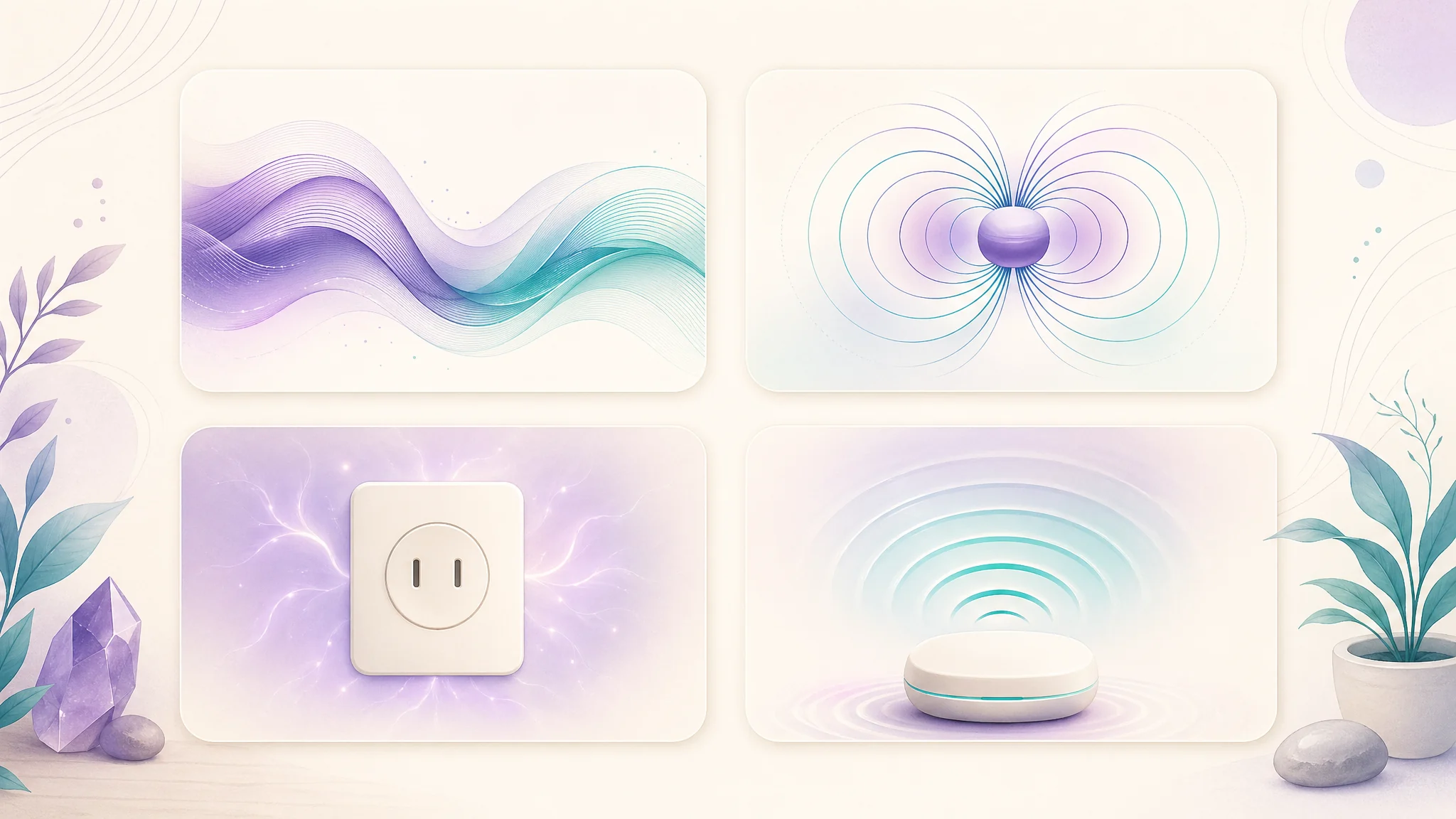
The four categories we most often discuss in homes are radiofrequency radiation, AC electric fields, AC magnetic fields, and dirty electricity. They can overlap in the same room, but they should be measured and reduced with different methods.
1. Radiofrequency radiation.
Radiofrequency radiation, or RF, is associated with wireless communication. In homes, common RF sources include Wi-Fi routers, mesh nodes, phones, tablets, Bluetooth speakers, smart watches, wireless security systems, smart thermostats, baby monitors, wireless printers, and smart meters. Nearby cell towers, broadcast antennas, and neighboring apartments can also contribute to background RF levels.
RF measurements are usually evaluated by location, distance, signal behavior, and time pattern. A router may transmit differently when idle, when streaming video, or when multiple devices are connected. A phone may behave differently in a strong signal area than it does when it is struggling to reach a tower. That is why a single quick reading can miss context.
Practical RF reduction usually begins with distance, placement, timing, and wired alternatives for fixed devices. Moving a router out of a bedroom, turning off unused wireless features, or using Ethernet for a desktop workstation can reduce unnecessary close-range exposure while keeping modern tools available.
2. AC electric fields.
AC electric fields are associated with voltage on wiring and cords. They can be present even when very little current is flowing. In a bedroom, relevant sources may include lamp cords, extension cords, power strips, chargers, adjustable beds, wiring behind a headboard wall, or ungrounded circuits.
Electric-field readings can vary with grounding, wiring layout, device placement, and body position. A plugged-in lamp next to a bed may create a different situation than the same lamp across the room. A phone charger on a nightstand can matter more because of proximity and duration, not because it is a large appliance.
Reduction strategies may include distance, cord routing, unplugging unused items near sleep areas, using properly grounded equipment, or correcting wiring conditions. Shielding and grounding should be approached carefully because they can help in some situations and create new problems if installed without measurement.
3. AC magnetic fields.
AC magnetic fields are associated with current flow. Common sources include electrical panels, meter bases, service lines, transformers, motors, appliances, wiring errors, and some equipment located behind walls or ceilings. Magnetic fields can pass through many ordinary building materials, which is why the source may not be visible from the room being measured.
Unlike many RF and electric-field concerns, magnetic-field issues are not always solved by simple shielding or moving a cord a few inches. If a bedroom wall backs up to a panel, a utility riser, or a shared electrical room, the source may be outside the room. If a circuit has a wiring imbalance, the best solution may be electrical correction rather than consumer mitigation products.
For magnetic fields, mapping matters. Readings should be taken at the places people actually spend time, then compared across nearby walls, floors, panels, and likely source areas. The goal is to determine whether the field is localized, persistent, load-dependent, or tied to a specific appliance or circuit.
4. Dirty electricity.
Dirty electricity is a common name for higher-frequency voltage noise on building wiring. It may be associated with dimmers, switch-mode power supplies, LED drivers, solar inverters, chargers, variable-speed motors, and other electronics. The term can be used loosely, so measurement method and interpretation are important.
Dirty electricity is evaluated at outlets or circuits rather than by simply standing in a room with a general-purpose meter. Some situations are minor. Others may point to a specific noisy device, a solar or inverter condition, or a pattern worth reviewing more carefully. Filters are sometimes marketed as universal fixes, but they should not be treated as automatic solutions. They can change the electrical environment and should be considered in context.
Why this matters.
When the field type is clear, the decision path becomes much calmer. RF questions may lead to router placement and wireless settings. Electric-field questions may lead to cord management or grounding review. Magnetic-field questions may lead to source mapping or an electrician. Dirty-electricity questions may lead to circuit testing and device isolation.
A measurement-first approach also helps homeowners spend money carefully. Instead of buying every product that sounds protective, you can ask whether the product addresses the field type actually present in the room. That is the difference between a practical EMF assessment and a fear-based shopping list.
Good questions to ask during testing.
- Which field type is being measured right now?
- What unit is the meter reporting, and what does that unit represent?
- Where are the highest readings compared with the places people spend time?
- Do readings change when a device is unplugged, moved, or switched to wired operation?
- Is the source inside the room, elsewhere in the home, or outside the property?
For examples of likely sources, see Common EMF Sources in a Modern Home. For professional help sorting field types, visit EMF consulting.
How the four categories can overlap.
A single room can contain more than one field type. A home office might have RF from Wi-Fi, electric fields from cords under the desk, magnetic fields from a nearby panel, and circuit noise from power supplies. Measuring one category does not automatically clear the others.
That overlap is why a good assessment moves in layers. It identifies the dominant source first, checks whether the source is close to a high-use location, then verifies whether practical changes improve the relevant reading.
Note: EMF Guru provides education and environmental measurement services, not medical diagnosis or treatment. If you have health concerns, work with a qualified healthcare professional. Measurements can help clarify environmental sources and practical exposure-reduction options.