
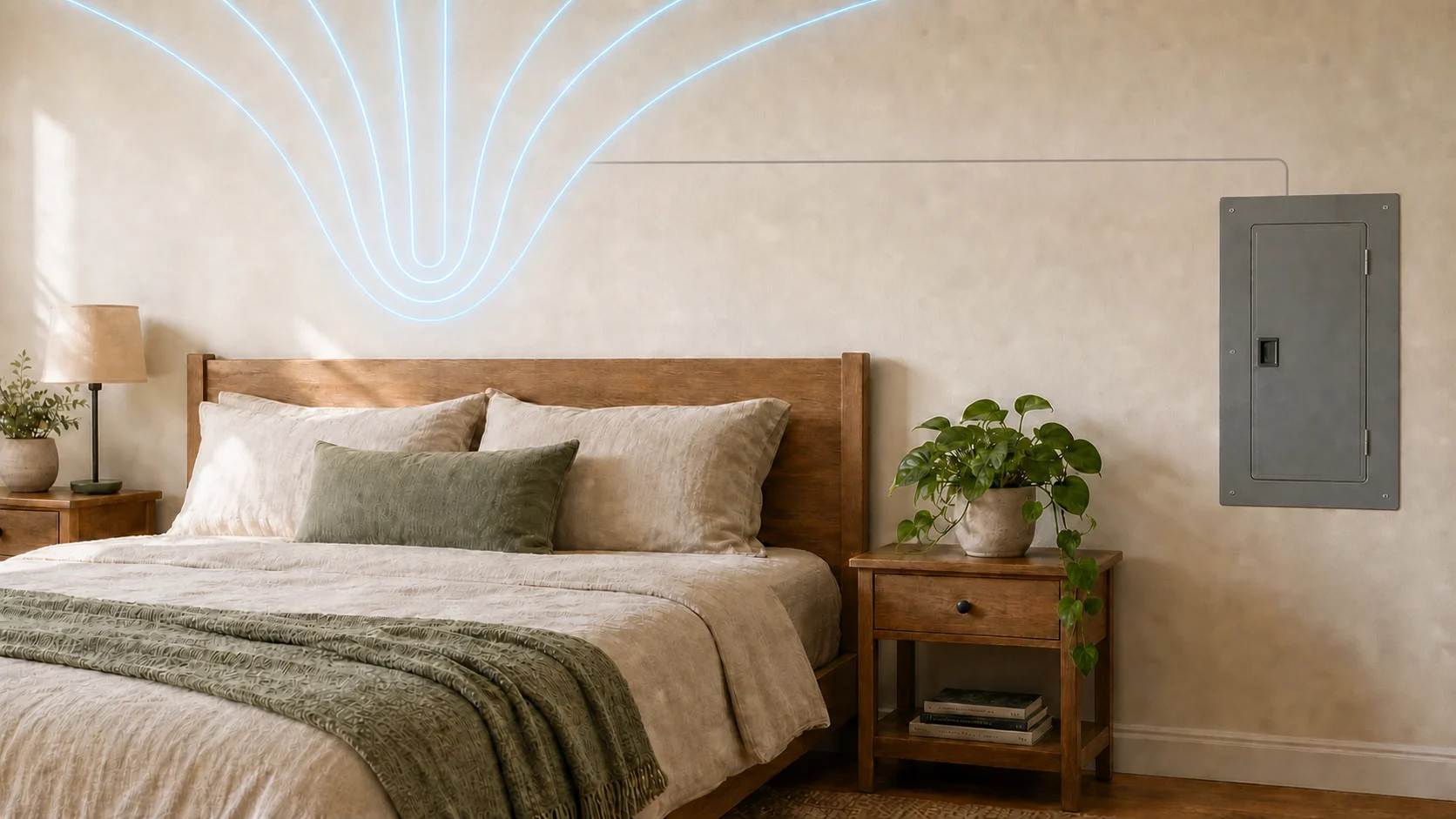
People often ask whether there is a recommended distance between a bed and an electrical panel. The sources reviewed here do not specify one, including health agencies, exposure standards, and electrical code checklists. That does not mean distance is irrelevant. It means the most useful answer depends on conditions in the home.
Magnetic-field readings near a panel can vary widely from one house to another because they are influenced by the wiring and current paths around the panel. Increasing distance may reduce a localized field, sometimes substantially. Measurements in the sleeping area can show whether moving the bed makes a meaningful difference in that room.
Is there a recommended distance between a bed and an electrical panel?
Not in any source we reviewed, and we looked specifically. The most on-topic statement from a US health agency is in the National Institute of Environmental Health Sciences booklet: “Magnetic fields from appliances decrease dramatically about an arm’s length away from the source. In many cases, rearranging a bed, a chair, or a work area to increase your distance from an electrical panel or some other EMF source can reduce your EMF exposure.”
A federal health institute names the panel, then gives no distance. Its appliance tables, widely cited as the source for panel figures, contain no panel row.
Why wiring and current paths matter near a panel.
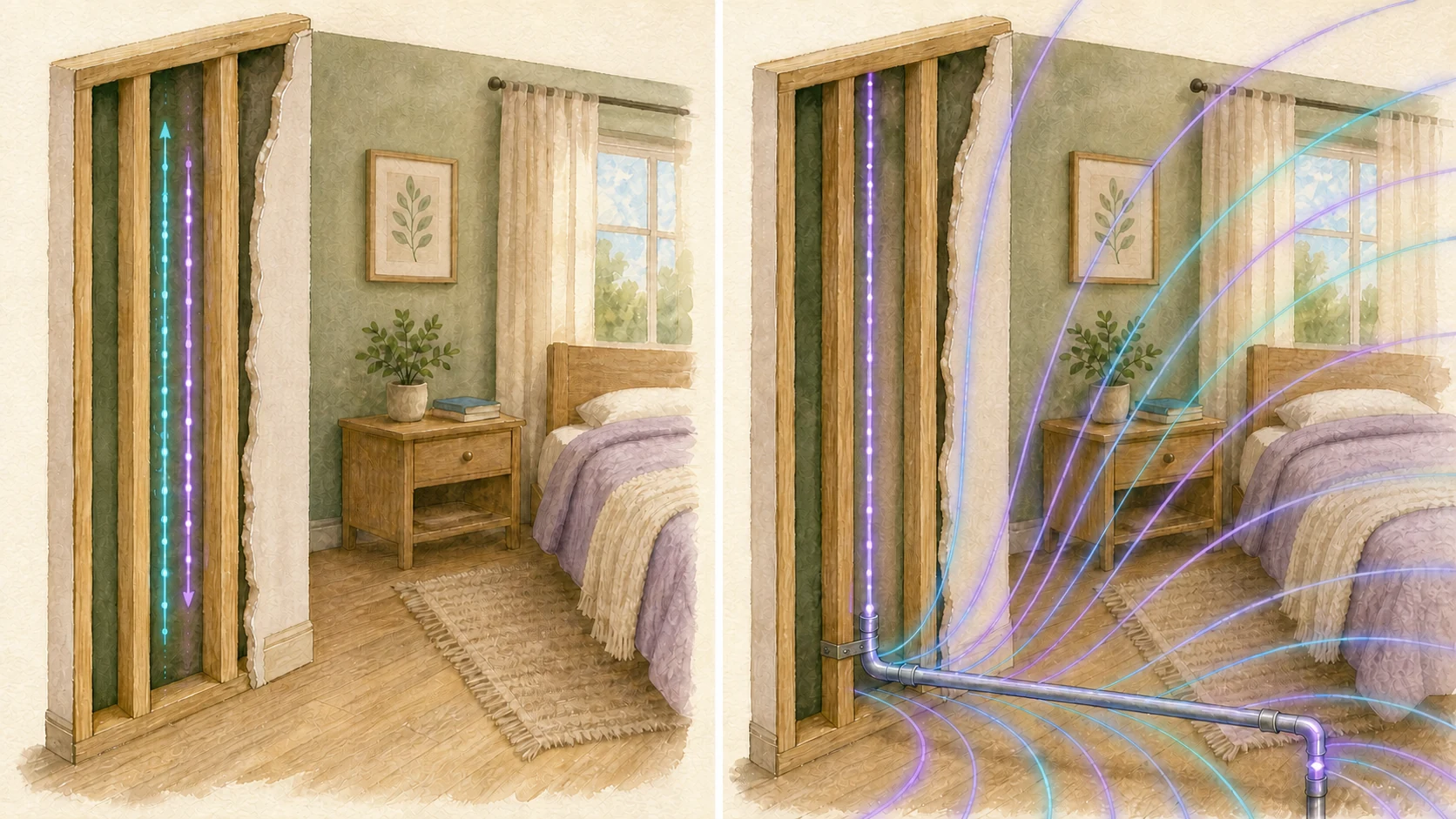
Magnetic-field readings near a panel are influenced by net current, the vector sum of the currents converging there. Current going out to your circuits is normally matched by current returning on the neutral, and two equal, opposed currents largely cancel. Cancellation fails when they are not equal, and WHO names three causes: neutral current diverted onto another return path, unintended neutral-to-ground connections, and uneven loading across the supply legs. The first is the one that reaches a bedroom, because such grounding currents flow “on various conducting services, such as water pipes, and these may pass through a home. Where this happens there can be a region of elevated field within the home.”
That is why distance can make a substantial difference in one home and much less in another. For a localized source WHO gives the steepest case as one in which “the field is reduced to an eighth with every doubling of the distance”. A whole-home background field instead falls “as one over the distance from the source, so varies comparatively little over the volume of a typical home”. Comparing readings at several locations can show how the field changes with distance, but it may not identify the underlying cause.
What counts as a normal reading in a bedroom.
NIEHS reports spot measurements from 992 US homes: half had an all-room mean of 0.6 milligauss or less, and the mean across all houses was 0.9 milligauss. Those are whole-home averages taken away from appliances, so a house averaging 0.6 can still have a higher reading in a sleeping area. Compliance limits are no help as a bedroom target, for reasons we set out in our note on FCC limits versus precautionary guidelines. The Building Biology Evaluation Guidelines provide precautionary sleeping-area bands: below 0.2 milligauss is classified as no anomaly, 0.2 to 1 as slight, 1 to 5 as severe, and above 5 as extreme. They state plainly that these values “are also recommendations and not legally binding exposure limits”.
Is it even legal to have an electrical panel next to a bedroom?
Yes. The National Electrical Code is a safety document about shock, fire, and access; it does not address magnetic fields, and the US Environmental Protection Agency confirms the wider position: “in the United States, there are no federal standards limiting electromagnetic fields from power lines and other similar sources.” NFPA 70 is copyrighted, so we cite dated adopting-jurisdiction checklists instead: the Minnesota 2023 NEC checklist keeps overcurrent devices out of bathrooms and away from easily ignitable materials such as clothes closets, and keeps the service disconnect out of bathrooms. Bedrooms appear on neither list.
One genuine code point gets garbled into an EMF rule. Section 110.26 requires 3 feet of clear working space in front of a panel, so a bed or headboard in that zone is a real violation if the panel is inside the bedroom. It is an access requirement with nothing to do with magnetic fields, and that 3-foot figure should never be repeated as an EMF safe distance. The most common configuration, a bed on the far side of a wall containing a flush-mounted panel, is addressed by none of these documents. Silent is not endorsed, and not prohibited.
So how far should your bed be from the electrical panel?
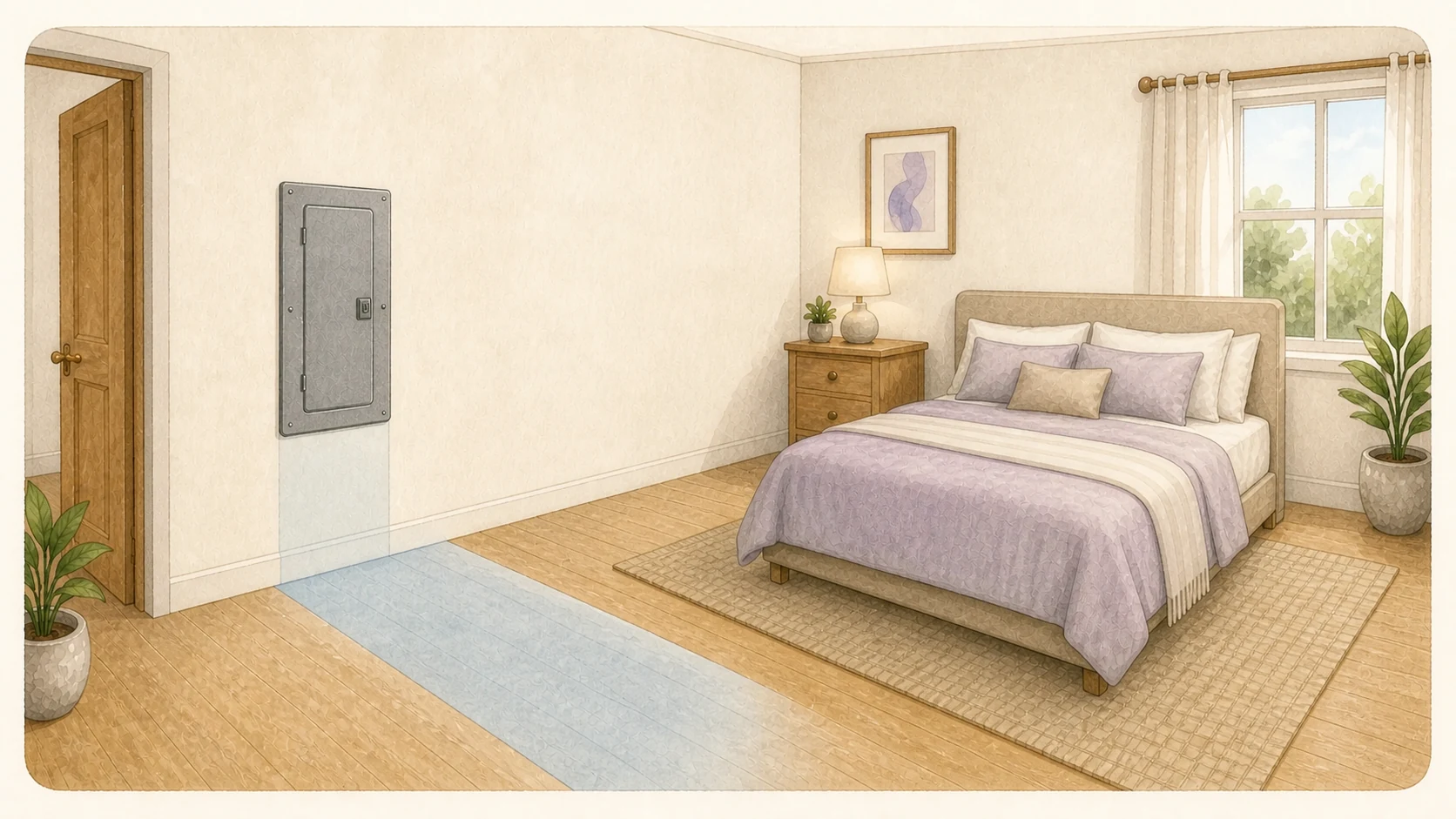
Far enough that moving the bed produces a meaningful and repeatable reduction in the sleeping area, if the layout allows it. The observations below are general examples, not a published protocol or a guarantee that a specific source or wiring condition can be identified. They reflect the measurement-first approach behind our note on EMF testing versus guessing.
1. Start with the sleeping area, not the panel face.
A reading at the panel face is not the same as a reading in the sleeping area. Starting where the bed is positioned provides more relevant context without assuming what the result means.
2. Compare readings at more than one location.
Readings at several locations can show whether the level changes with distance. A pattern may suggest that a source is more localized or more broadly distributed, but the pattern alone does not establish the cause.
3. Repeat a spot reading before drawing conclusions.
Spot readings can differ as electrical loads change. Comparing spot readings taken under similar conditions can provide useful context, but the comparison does not identify a circuit, service conductor, grounding path, or wiring condition.
4. Keep spot comparisons consistent.
Use the same location and meter orientation when comparing spot readings. A consistent setup makes before-and-after comparisons easier to interpret without implying that a reading identifies the cause.
5. Move the bed and measure again.
If the room allows it, compare readings before and after moving the bed to another practical position. A consistent reduction may support a simple, low-cost change. If readings do not change as expected, that result alone does not establish why.
When the reading stays elevated after you move the bed.
If readings remain elevated after the bed is moved, the source may not be limited to the original furniture location. That result does not diagnose a wiring condition, and a qualified electrician may be needed to evaluate the electrical system. WHO advises local authorities to “enforce wiring regulations to reduce unintentional ground currents when building new or rewiring existing facilities, while maintaining safety.”
It is also worth knowing what will not work. Magnetic fields are diverted only by high-permeability materials such as iron, and WHO calls shielding them that way “in practice only an option to protect small areas”. Conductive paints and fabrics are conductors, so they address electric and radio frequency fields, not magnetic fields from wiring. That is the same conclusion we reach in our review of whether EMF shielding paints and fabrics actually work. Knowing which of the four types of EMF we measure in homes you have prevents most wasted spending, and our overview of why the bedroom is the first place to check explains why we start where you sleep.
Frequently asked questions about beds and electrical panels.
Where does the six-foot rule for beds and electrical panels come from?
Not from any source we reviewed: not the NIEHS booklet, WHO EHC 238, the IARC monograph, the ICNIRP guidelines, or the code checklists cited here. The three-foot version is usually a garbled retelling of the section 110.26 working clearance, an access requirement with no exposure meaning.
Why is the field near my panel higher than my neighbor’s?
Readings can differ because net current and nearby current paths vary from one home to another. Diverted neutral current, unintended neutral-to-ground connections, and uneven loading across the supply legs are possible contributors. A field reading alone does not identify which condition, if any, applies in a particular home.
Is it against code to have an electrical panel behind my bed?
Not according to the adopting-jurisdiction checklists cited here. Overcurrent devices are restricted from bathrooms and from near easily ignitable material, and the service disconnect must not be in a bathroom. Bedrooms are not restricted, and those documents say nothing about the far side of a wall.
Will moving my bed actually lower the reading?
Sometimes substantially, sometimes not at all. A localized source can fall off steeply, and WHO gives the steepest case as an eighth of the field per doubling of distance. A field influenced by net current may change much less across a room. Comparing readings before and after a move can show whether the change helps in that location.
The bottom line on beds and electrical panels.
The question has no published answer because the useful distance depends on conditions in the home. WHO’s test for proportionate precaution is that “implementing very low-cost precautionary procedures to reduce exposure is reasonable and warranted.” Moving a bed can meet that test because it is low cost and reversible. Ripping out walls or buying shielding products before the source is understood does not, and no source here supports it. That is the proportion we apply in our guide to reducing EMF exposure without going off grid. If moving the bed consistently lowers the reading, it may be a practical step. If readings remain elevated, further assessment can help determine whether an electrician should evaluate the wiring.
When a professional assessment may help.
No general distance rule can account for every home’s wiring and current paths. Measurements can provide useful context, though they do not guarantee that a specific cause will be identified. A professional assessment may be helpful when:
- Your bed shares a wall with the panel, the meter, or the service entrance.
- You have moved the bed already and the reading did not change as expected.
- You are concerned that a wiring condition may be contributing and want to know whether follow-up by a qualified electrician is warranted.
- You are buying or renovating and want the panel location assessed before the layout is fixed.
EMF Guru provides measurement-first consultations in the greater Portland area. We compare spot readings in the sleeping area and at practical alternative bed positions, then explain whether repositioning appears to make a meaningful difference. When the findings suggest that the electrical system may warrant attention, we can recommend follow-up with a qualified electrician. Results vary, and a consultation may not identify a single source or cause. A consultation is environmental education and planning, not electrical, medical, diagnostic, or treatment services. Start with the bedroom testing overview or schedule an EMF consultation.
Sources referenced for this Field Note.
- National Institute of Environmental Health Sciences, EMF: Electric and Magnetic Fields Associated with the Use of Electric Power, Questions and Answers (2002)
- World Health Organization, Extremely Low Frequency Fields, Environmental Health Criteria 238 (2007)
- ICNIRP, Guidelines for Limiting Exposure to Time-Varying Electric and Magnetic Fields (1 Hz to 100 kHz) (2010)
- IARC Monographs Volume 80, Non-Ionizing Radiation, Part 1: Static and Extremely Low-Frequency Electric and Magnetic Fields (2002)
- Institut fuer Baubiologie und Nachhaltigkeit, Building Biology Evaluation Guidelines SBM-2024
- US Environmental Protection Agency, Electric and Magnetic Fields from Power Lines
- Minnesota Department of Labor and Industry, Electrical Inspection Checklist, 2023 NEC (revised 6 May 2023)
- City of Saint Paul Department of Safety and Inspections, Residential Dwelling Checklist, 2023 NEC (June 2023)