

A standard home inspection won't measure EMF. The InterNACHI standards many inspectors follow list "the existence of electromagnetic fields" among the things an inspector is not required to determine. Oregon's rules don't require inspectors to look for suspected environmental hazards either. Inspection day is still the best day to ask where the power comes in, what the inspector found in the wiring and what is outside, and then to book a measurement before your window closes.
A standard home inspection does not cover EMF.
Under the InterNACHI Standards of Practice, revised in October 2022, an inspector is not required to determine "the existence of electromagnetic fields." Oregon's rule, OAR 812-008-0204, says certified inspectors don't have to determine "any suspected adverse environmental condition." So if you want EMF readings, you have to ask for them separately.
That doesn't make the inspection useless for EMF. Under InterNACHI's standards the inspector looks at the service drop, the electric meter and base, the main disconnect, the panel and "a representative number of switches, lighting fixtures and receptacles." The inspector reports what they see, and you can use those findings.
Where does the power come in, and which rooms share a wall with it?
Ask the inspector, or just walk the outside of the house, to find where the overhead or underground service enters, where the electric meter sits and where the main panel is. Then go inside and note which rooms share a wall with them, especially bedrooms and a home office.
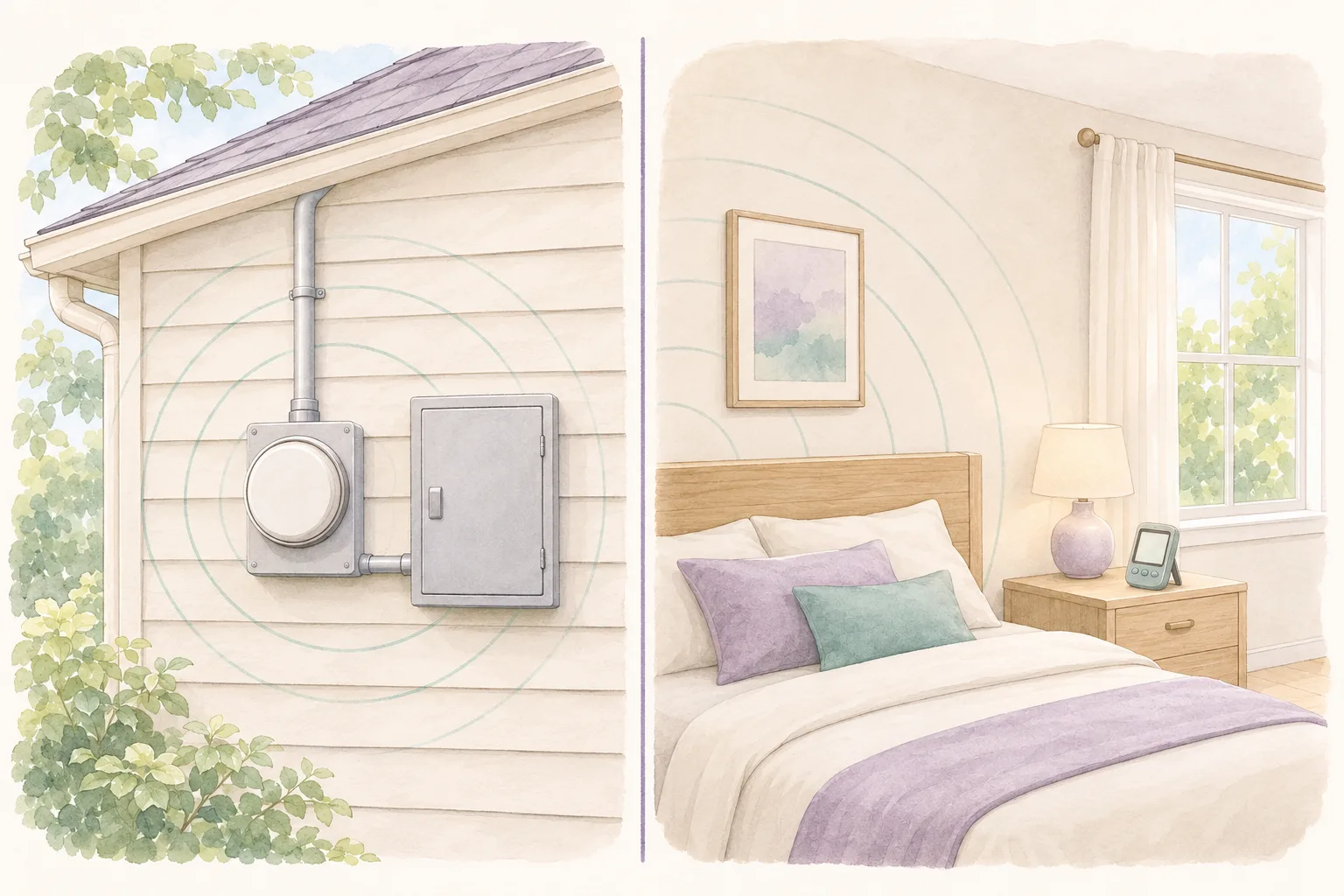
This matters because, as the NIEHS puts it, "magnetic fields are not blocked by most materials" and they "rapidly become weaker with distance from the source." A bed on the other side of the panel wall is a different situation from a bed across the house. Our guide to how far your bed should be from the electrical panel covers what a few feet can change.
What did the inspector find in the wiring?
InterNACHI's standards ask the inspector to report outlets where "polarity was incorrect," where the receptacle "was not grounded," and any "evidence of arcing or excessive heat." Those are electrical issues first, and a licensed electrician should fix them. Ask for the list, the room each issue was found in and any photos.
Those findings can matter for EMF as well. The NIEHS notes that house wiring "is often a significant source of EMF exposure," and that the fields it produces "depend on the amount of current flowing." A measurement can show whether a room with a flagged circuit actually reads high. Please don't open the panel or test wiring yourself. The inspector reports, an electrician corrects, and a measurement confirms.
What is outside on the poles, lines and rooftops?
Stand at the front and back of the lot and look up. Note overhead lines along the street or the back property line, any pole-top transformer near a bedroom side of the house, larger transmission lines nearby, and antennas on poles or rooftops. Take photos so you can compare them with measured readings later.
The NIEHS says that "people living close to high voltage power lines that carry a lot of current tend to have higher overall field exposures," and that appliances and building wiring add to what most people get at home. For scale, the same NIEHS booklet says most people in the United States are exposed to magnetic fields that average less than 2 milligauss, although individual exposures vary. A visible line or antenna is a reason to measure. It does not tell you the level. If a cell site is the worry, our guide to buying a home near a cell tower walks through what to check.
Which sources stay with the house, and which leave with the seller?
Sort what you see into two lists. The service drop, panel, wiring, nearby power lines and the utility's smart meter stay with the house. The seller's Wi-Fi router, cordless phone base, chargers and smart speakers leave on moving day. The first list is the part you're actually buying.
A few items fall in between, so ask about them. Is there a solar inverter, or an EV charger in an attached garage under a bedroom? Our posts on EV chargers and the room above the garage and on smart meter opt-out fees explain what tends to matter. Also ask the sellers whether any electrical work was done without permits.
Book a measurement before your inspection window closes.
The inspection period in most purchase contracts is when you can ask for repairs or reconsider, so measure inside it. A useful reference comes from a national survey reported by the NIEHS: in 992 U.S. homes, half had an average room magnetic field of 0.6 milligauss or less, and the average across all homes was 0.9 milligauss.
Those survey figures are averages across whole homes. They are not safety limits, and a single spot reading isn't directly comparable. The useful comparison is your own: measure the bedrooms in the home you're buying and in the home you live in now, so the numbers mean something to you. Our page on EMF testing in Portland explains what a local assessment covers. Ask the sellers for permission to switch off and unplug the devices that will leave with them, such as routers, chargers and smart speakers, then take readings room by room. The numbers then show what you are actually buying: the wiring, the panel, the service and the sources outside.
Frequently asked questions about EMF and home inspections.
Will my home inspector check for EMF?
Usually not. InterNACHI's standards exclude "the existence of electromagnetic fields," and Oregon's rules don't require inspectors to determine suspected environmental hazards. Some inspectors offer extra services, so ask, but a general inspection report does not include EMF readings.
Can I bring my own meter to the inspection?
You can ask the seller's agent, since the visit happens on the seller's property. Consumer meters can show where readings are higher, but they vary in accuracy, and readings change with how much power the household is using at the time.
Should a wiring problem in the report worry me about EMF?
Treat it as an electrical repair first and have a licensed electrician fix it. Magnetic fields from wiring depend on the current flowing through it, so a measurement after the repair shows what the room actually reads.
Is a house near power lines a bad buy?
Not automatically. Fields from lines drop with distance, and the current on the line matters. Measure the bedrooms and the rooms you use most, compare them with your current home, and decide with real numbers.
Sources referenced for this Field Note.
- InterNACHI: International Standards of Practice for Performing a General Home Inspection. Revised October 2022. The EMF exclusion and what an inspector checks and reports in the electrical system.
- Oregon Administrative Rules, OAR 812-008-0204: General Exclusions. What Oregon certified home inspectors are not required to determine.
- NIEHS: EMF, Electric and Magnetic Fields Associated with the Use of Electric Power. June 2002. How wiring and power lines affect home magnetic fields, and the 992-home survey figures.