
Many homeowners first look into smart meter options after noticing that a wireless meter sits near a bedroom, office, nursery, or other frequently used area. Some are also trying to sort through health-adjacent RF exposure concerns without turning the decision into guesswork.
That usually leads to a practical question: what options do I have? Should you ask the utility about a smart meter opt-out program or use a shielding product?
There is not one answer for every house. The better approach is to separate three different decisions:
- What the utility allows
- What the smart meter is doing at this specific location
- Whether any change can be measured afterward
That keeps the conversation grounded. A utility opt-out or non-network meter program may reduce or remove one wireless source, but it can come with fees, restrictions, or availability limits. A smart meter cover may be useful in some situations, but it should not be treated as a guarantee. Measurement helps homeowners avoid guessing in either direction.
Start by assessing your options.
The goal is to understand the actual environment around the meter and make a reasonable choice. Useful questions include:
- Is the smart meter on an exterior wall next to a bedroom, bed, desk, nursery, or favorite sitting area?
- Is the meter bank shared with other units, as in a duplex, apartment, condo, or townhome?
- Does the utility offer an opt-out meter option, and what does it cost to install or read?
- Would a smart meter cover physically fit the meter without interfering with utility access?
- Can the result be measured before and after any change?
Those questions matter more than product claims or general online advice. A meter mounted on a detached garage is a different situation than a meter mounted directly behind a headboard.
What a utility opt-out does.
A smart meter opt-out program is a utility policy, not a product. Depending on the utility, it may allow a customer to keep an existing non-standard meter, request a non-network meter, reduce wireless meter communication, or use a different meter-reading arrangement.
Fees are part of the decision, but they are not the whole decision. Utilities often charge because non-communicating meters require manual reading or special handling. The cost may be a one-time meter exchange, a monthly read fee, or both.
The practical advantage of an opt-out is that it addresses the source at the utility level. If the wireless transmitter is removed or disabled, there may be no need to manage RF from that meter position.
The practical downside is cost, eligibility, and control. A monthly fee can add up, some programs have owner-authorization or rate-plan limits, and the homeowner still needs to understand whether there are other nearby RF sources, such as neighboring meters, Wi-Fi equipment, cell signals, or wiring issues.
Opting out is not the same as testing the home. It is one possible source-control decision.
Greater Portland smart meter opt-out links.
Start with your own utility’s current policy. The names, meter types, fees, and eligibility rules are not identical. Here are some options in the Portland area:
- PGE Oregon: PGE tariff materials provide for a residential non-network meter request under Rule M. PGE’s Schedule 300 charges list a $158 one-time installation charge and a $30 monthly non-network meter read charge. If the customer is not the owner, Rule M requires owner authorization. The tariff also says non-network meter customers are not eligible for time-of-use rates and may be excluded from future programs that require a network meter.
- Pacific Power Oregon: Pacific Power’s smart meter opt-out information says Oregon customers can opt out for a $10 monthly meter-reading fee. If a customer opts out before smart meter installation, the existing meter can stay in place. Pacific Power also lists a $3 monthly Triannual Read Equal Pay option for eligible residential customers with non-standard meters, and a $169 exchange fee if an Oregon customer asks to remove an existing smart meter.
- NW Natural: NW Natural says its gas meters use one-way AMR/ERT communication, not two-way smart meter communication. Its meter update information says customers cannot opt out of selected meter updates or choose a meter model, but NW Natural’s meter safety information says customers may request ERT removal at their expense. NW Natural lists a minimum $172 ERT removal charge, plus ongoing monthly charges for manual gas meter reading.
- Clark Public Utilities, Vancouver and Clark County: Clark’s My Meter Exchange page says meter exchanges are scheduled to begin in 2027 and continue through 2028, but customer opt-out options and potential costs have not been determined yet. Clark lists 360-992-3000 for questions.
These costs should be treated as planning information, not as the whole decision. A utility opt-out or non-network meter option and a measured shielding approach can both be practical. Which one fits depends on policy, cost, meter location, utility access rules, and before-and-after readings in the rooms people actually use.
What a smart meter cover is trying to do.
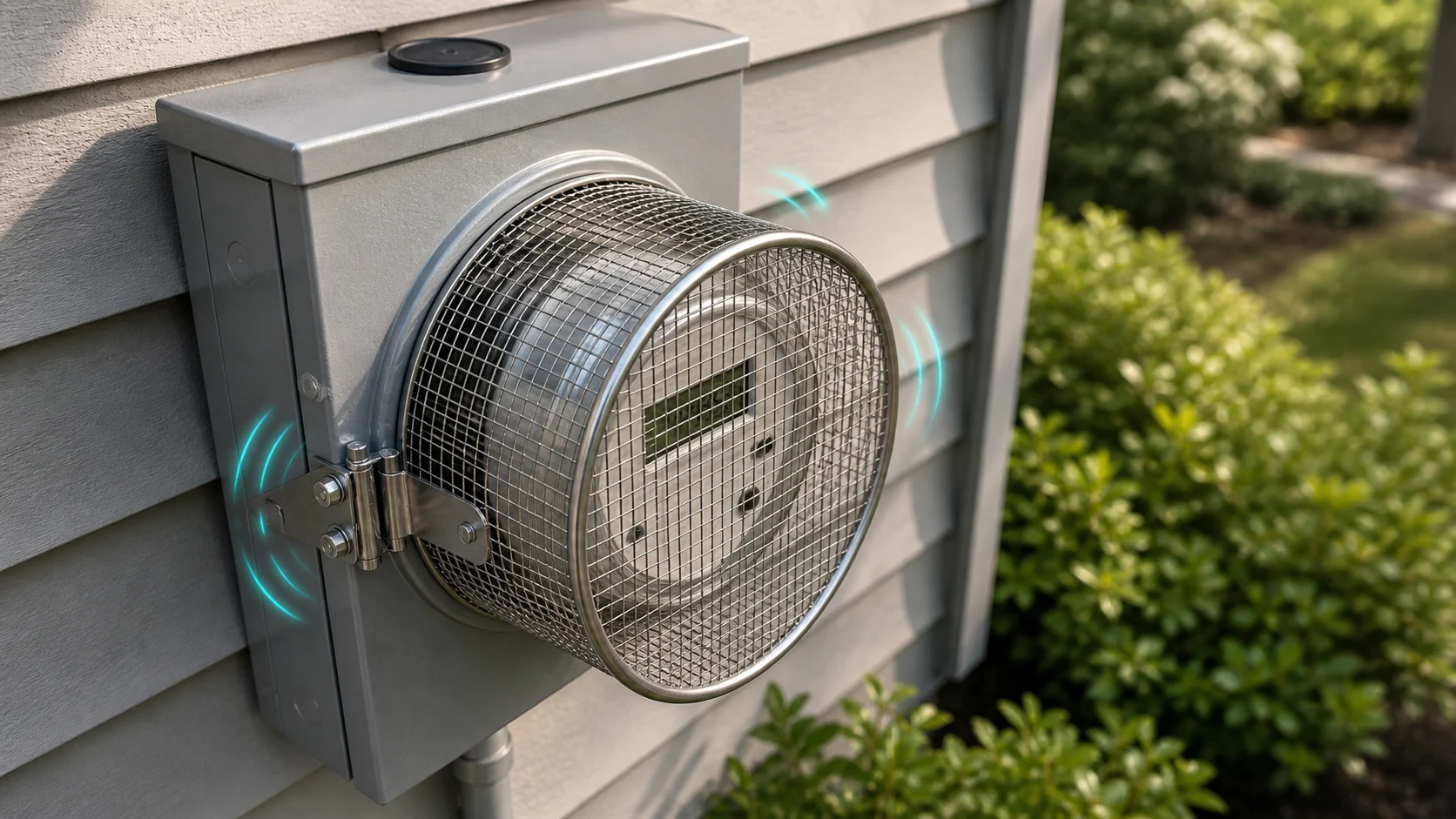
A smart meter cover is a product intended to reduce radio frequency exposure from a wireless smart meter by placing shielding material around the meter face while leaving the meter visible and accessible.
Disclosure: EMF Guru may receive compensation if you purchase through the Smart Meter Guard link below. The recommendation is still measurement-first: verify the actual RF change in the home and avoid guaranteed health claims.
A product such as Smart Meter Guard may be a practical candidate for homeowners who cannot opt out, do not want to pay a recurring fee, or want to reduce RF from a meter location without changing the utility account. But the product should be framed as a measurable shielding option, not as a cure-all.
The key question is not whether a product sounds convincing. The key question is whether it changes the readings in the places people actually spend time.
Why RF precaution is still a reasonable conversation.
Smart meters are one source of radio frequency (RF) energy in the home. For most households, the practical question is not whether a smart meter has been proven to cause a disease. That is not what this article is claiming. The practical question is whether a known RF source is close to a bed, desk, nursery, or other long-use location, and whether reducing avoidable exposure is reasonable.
There is credible scientific and regulatory context for taking that question seriously. The WHO’s International Agency for Research on Cancer classified radiofrequency electromagnetic fields as possibly carcinogenic to humans (Group 2B). The U.S. National Toxicology Program reported animal findings from high-level RF exposure, and the Ramazzini Institute published a lifetime animal study of base-station-like RF exposure. Those studies are not residential smart meter studies, and they do not prove that a smart meter in a specific home will cause harm.
The regulatory picture is also nuanced. In Environmental Health Trust v. FCC, the D.C. Circuit sent the FCC’s 2019 RF-guideline decision back for a fuller explanation, including around non-cancer effects, long-term exposure, children, and other issues. The court did not decide the science. It said the agency needed to explain its reasoning better.
That is why EMF Guru keeps the guidance practical: treat smart meters as one RF source, reduce avoidable exposure when the meter location makes sense, and verify any change with measurement. For broader context, see EMF Guru’s EMF studies and FCC limits vs precautionary guidelines.
Why measurement matters before and after.
Many wireless meters communicate intermittently rather than as one steady, visible signal, and transmission behavior varies by utility, meter model, and network. That can make casual observation misleading. A meter may look quiet for a moment, then transmit later. A simple meter reading can also vary depending on position, direction, building materials, and nearby sources.
A useful smart meter check usually compares:
- RF levels near the meter before any change
- RF levels at the interior wall behind or near the meter
- RF levels at the bed, desk, couch, or other long-use location
- Readings before and after a cover or other change
- Whether other RF sources are present in the same area
This is where shielding products need a measured follow-up. If a cover reduces readings at the meter face but does not meaningfully change the room where someone sleeps or works, the practical value is different than if it reduces readings at the long-use location.
Measurement also helps prevent false confidence. A homeowner may install a cover and assume the smart meter issue is solved, while the stronger RF source is actually a Wi-Fi router, mesh node, phone, or neighboring equipment.
Limits of smart meter covers.
Smart meter covers have practical limitations.
They do not remove the meter. They do not address every direction equally in every building condition. They do not solve magnetic fields, electric fields, dirty electricity, or wiring issues. They may not be allowed by every utility or meter setup. They also need to be installed in a way that does not block required utility access, damage equipment, trap heat, or violate local rules.
Shielding can also be unintuitive. RF can reflect, diffract, and move through openings or building materials in ways that are not obvious by sight. A product may perform well in one setup and less well in another.
That is why the language around any smart meter cover should stay practical:
- It may reduce RF from a specific smart meter location.
- It should be checked with measurement.
- It is not a medical device.
- It does not guarantee a health outcome.
- It is only one part of a whole-home EMF picture.
A practical decision sequence.
If you are comparing a utility opt-out or non-network meter option with measured shielding, use this order.
1. Identify the meter location
Start with the layout. Is the meter on the other side of a bed, desk, nursery, or living area? Is it on a garage wall, exterior service wall, or shared meter bank?
2. Check the utility policy
Find out whether your utility offers an opt-out, non-network, or non-standard meter option, what it costs, and what meter arrangement it actually provides. Do not assume that every utility uses the same language or fee structure.
3. Measure the current condition
Before buying a cover or paying a recurring fee, measure what is actually happening at the long-use areas that matter. If measurement is not available yet, at least map the meter location and nearby rooms carefully.
4. Compare policy cost against one-time products
A utility opt-out may be worth it for some households, even with a monthly meter-reading fee. For others, a one-time shielding product may be worth considering, especially if the meter location is the main concern and the result can be verified.
5. Install only if it is allowed and appropriate
Any smart meter cover should fit the meter style, preserve visibility and access, and avoid interfering with utility requirements. When in doubt, check the product instructions and utility rules before installation.
6. Re-measure after the change
The after-reading is the proof point. Check the same places you measured before, especially the interior long-use locations. Keep the result specific: this setup improved, did not improve, or needs more investigation.
When a professional assessment helps.
A professional EMF assessment can help when:
- The meter is mounted directly behind a bed, nursery, desk, or other long-use area.
- There is a shared meter bank on the building.
- You are not sure whether the smart meter is the main RF source.
- You want before-and-after readings for a shielding product.
- You are comparing an ongoing opt-out fee with a one-time mitigation option.
- You also want to check magnetic fields, electric fields, dirty electricity, Wi-Fi, and nearby wireless sources.
For a measured check, start with EMF Guru's EMF Testing in Portland overview or contact EMF Guru consulting before paying recurring fees or buying mitigation products.
The value of an assessment is not just the number on a meter. It is the context: where the source is, how it changes with distance and direction, whether the concern is actually the smart meter, and which next step is proportionate.
The bottom line with smart meters.
Utility opt-outs, non-network meter programs, and smart meter covers solve related but different problems.
An opt-out is a utility-policy option that may reduce or remove the wireless meter source, but it can come with recurring fees, installation charges, eligibility limits, and access requirements. A product such as Smart Meter Guard may be a useful shielding option in some homes, but it needs measured follow-up and realistic expectations.
The best path is simple: identify the meter location, check the utility policy, measure the current condition, make the least complicated change that fits the home, then measure again.
That is the difference between buying on hope and making a decision from evidence.