
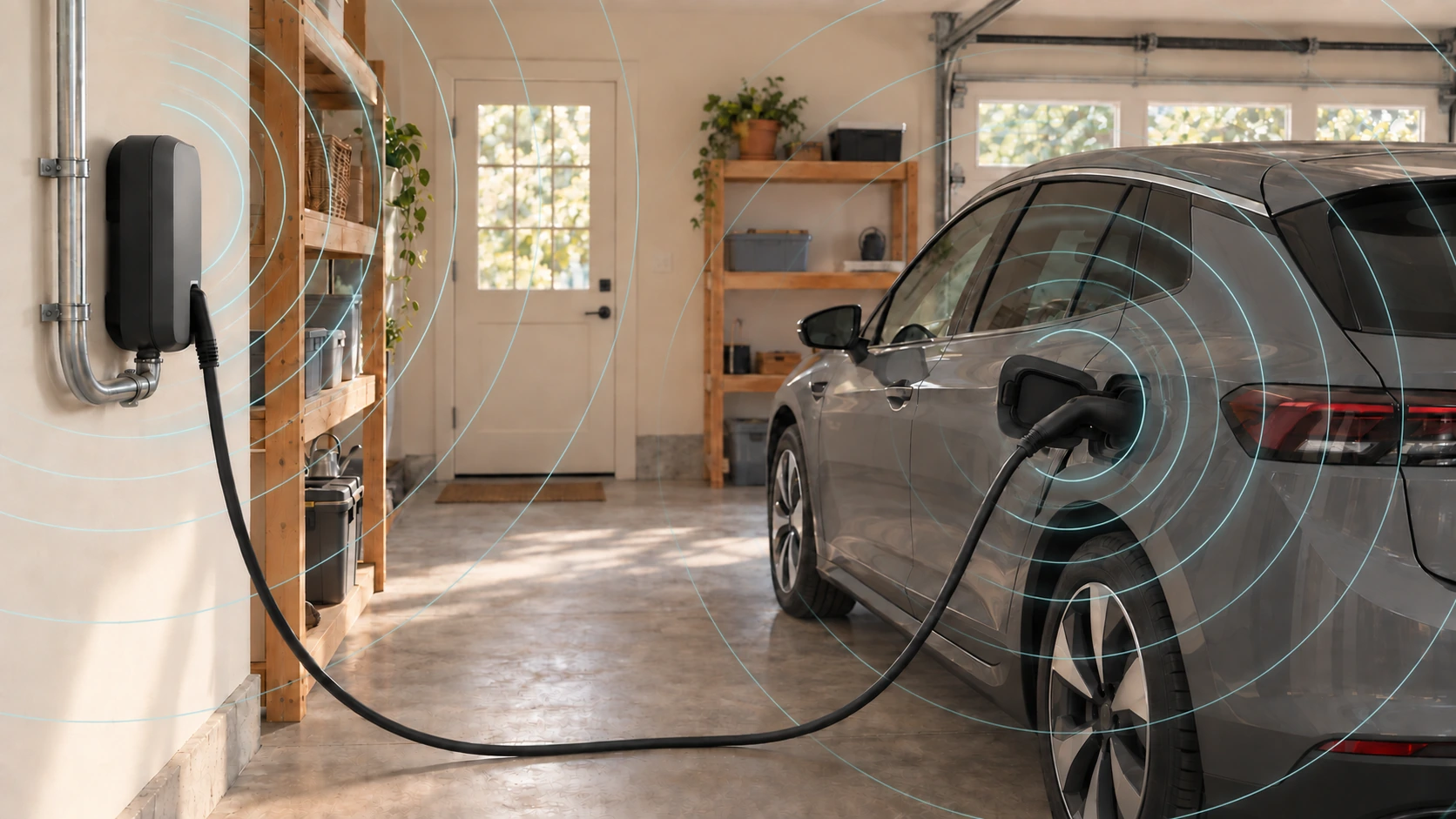
Charging an electric car does add electric and magnetic fields inside an attached garage. Whether it changes anything in the room above is a separate question, and the answer depends on the equipment, the wiring, how hard the car is charging and where you take the reading. A meter held next to the wall unit cannot answer it. Measuring the same spot upstairs twice, once with charging off and once with charging on, can.
The wall unit is only part of the charging system.
The box on the garage wall is not really the charger. It passes household electricity to the car, and equipment inside the car does the converting. House power arrives as alternating current, or AC, and a battery stores direct current, or DC. The Department of Energy describes that conversion happening onboard the vehicle. So four things matter, not one: the wall unit, the cable, the car, and the household wiring feeding them.
The wall unit’s formal name is electric vehicle supply equipment, which manuals shorten to EVSE. The Department of Energy describes Level 1 as a standard 120 volt outlet and residential Level 2 as typically 240 volts, the kind of circuit an electric dryer uses. Those labels describe how the car is fed. They say nothing about what a bedroom reads. Public fast charging and wireless pads are different systems, outside this comparison.
Electric and magnetic fields are two different measurements, and one meter setting does not cover both. WHO explains that electric fields come from voltage, present whenever a wire is live even with nothing switched on, while magnetic fields come from current, the actual flow of electricity. Wi-Fi on the unit is a third kind of signal again. Our guide to the four types of EMF measured in homes explains why one meter mode cannot stand in for all of them.
The room above needs its own measurement.
An attached garage is a reason to check the room above it, not evidence that anything is happening there. WHO lists ordinary house wiring and appliances as everyday contributors to the same kind of field, so the garage is one source among several. The reading that matters is taken at the bed or the desk, with the charging state written down, rather than against the garage wall where the number will always be highest.
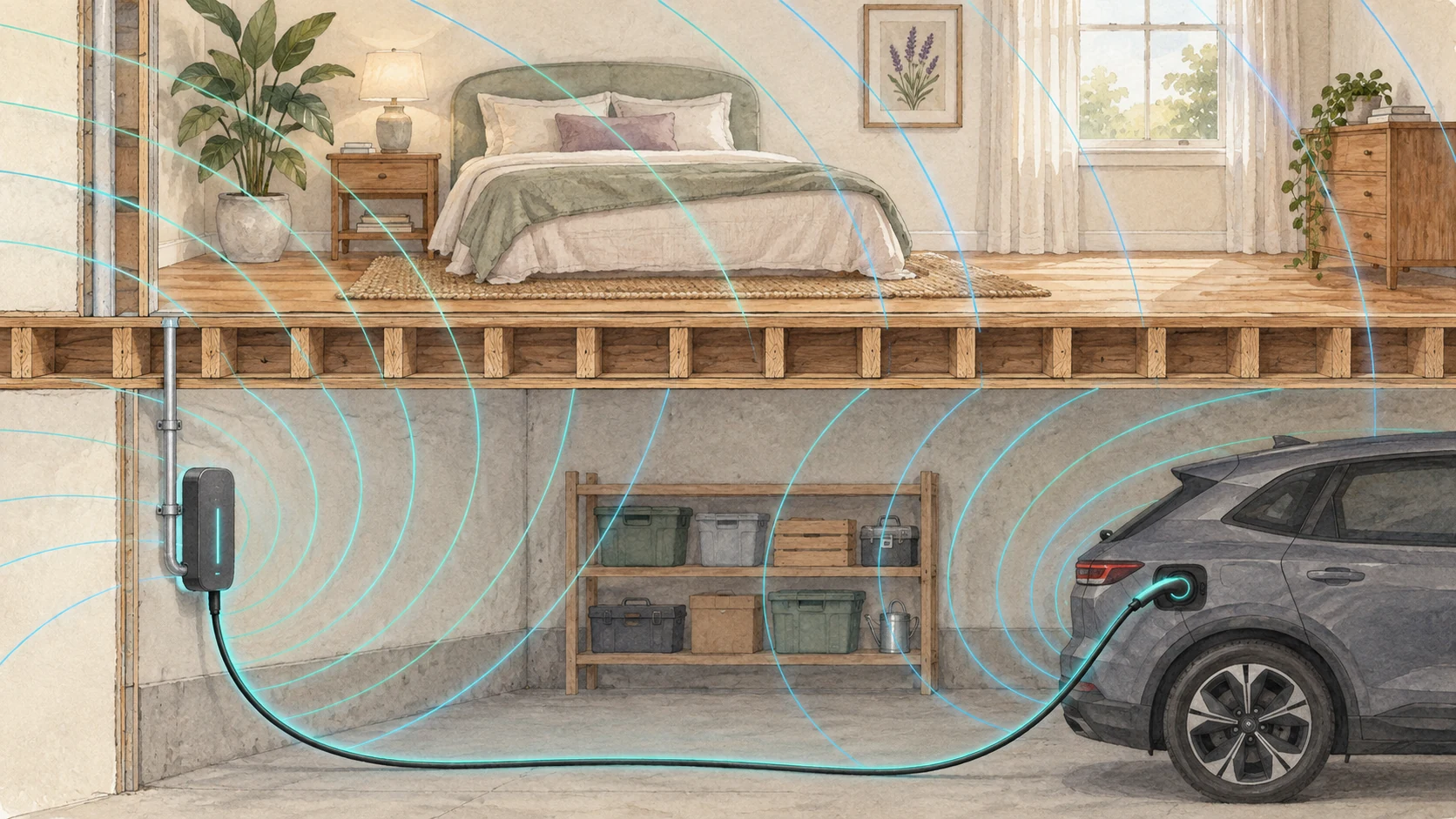
Electric vehicles are common across the Portland area, and a garage under a bedroom is one of the places this question comes up most. For anyone deciding whether to charge overnight below where they sleep, the useful question is how that one installation relates to the spot where they spend eight hours. A floor plan helps locate the wall unit, the car and the known cable routes, but it cannot produce a reading.
Two assumptions are worth avoiding: that a floor blocks the field, and that a source downstairs must produce a large change upstairs. In this Field Note, “meaningful” means a change that repeats, and that is large enough to tell apart from normal background variation and the meter’s own margin of error, at the spot where someone actually is. It is not a health threshold.
Compare the same locations with charging off and on.
A comparison is only useful if everything except the charging stays the same. ICNIRP’s low-frequency overview keeps the two quantities separate: electric fields counted in volts per metre, magnetic fields in tesla or gauss. House power runs at 60 Hz in the United States and 50 Hz in much of the world. A meter set for that low range is not reading Wi-Fi, and may not catch everything the charging electronics produce.
What follows is suggested observation guidance, not a published test standard, an electrical inspection, or a certified compliance procedure.
- Start with a meter built for the field you are asking about. The wrong meter reads low, and a low number from the wrong meter is not evidence that nothing is there.
- Take the first reading at the pillow, then pick one other spot where real time is spent.
- Hold the meter the same way every time: same position, same height, same angle. Readings taken differently are not comparable.
- Read with charging off, start charging as you normally would, then read the same spots again. Then run that whole sequence once more.
- If the question is about sleeping hours, log a stretch of charging that covers a normal night. One instant is not an overnight picture.
If the same change appears again and is bigger than the meter’s margin of error, it is associated with charging under those conditions. That is not proof that the wall unit alone caused it. If no change resolves, this method found none at those spots at those times; it does not mean nothing is emitting anywhere. EMF testing versus guessing explains why documenting the comparison is the part that matters.
A measurement is not a health verdict.
A room comparison describes a condition in a building. It says nothing about anyone’s health. ICNIRP works with two kinds of number: one describes what is happening inside the body and cannot be measured with a household meter, the other is an external level you can measure, set deliberately low so that staying below it keeps the internal figure well within range. A bedroom reading, a personal preference for keeping exposure low, and a formal guideline comparison are three separate things.
ICNIRP reports that studies have found an association between long-term, low-level 50 to 60 Hz magnetic-field exposure and childhood leukemia, while stating that the existing evidence does not establish that the fields cause it. ICNIRP also describes the evidence on symptoms and sleep quality as inconsistent. These are broad assessments of low-frequency fields generally, not studies of EV charging in bedrooms above garages.
No compliance claim is being made here; that would require naming the applicable guideline, frequency, population and measurement method. Going above one of those external levels does not automatically mean the internal limit was passed, because they are set conservatively on purpose. A single reading says nothing about long-term exposure, and neither a lower number nor a different charging schedule is a promise of better sleep. None of this is a legal determination for an Oregon home.
Choose changes that improve the reading you care about.
Pick a change because it produces a repeatable improvement where someone actually sits or sleeps, not because the equipment looks imposing. WHO separates magnetic fields, which come from current flowing, from electric fields, which come from voltage being present. That has a practical consequence: stopping the battery charging stops the current, but it does not mean every field around a live installation has gone away.
If the readings do show a charging-related increase worth acting on, weigh the options: charging at a different time, a lower current setting if the manufacturer offers one, or moving the bed or desk. Then measure the same spot again. A lower current setting usually means a longer session, so the tradeoff is not obvious from the label alone.
Before relocating a wall unit or rerouting a circuit, bring in a qualified electrician. Do not open equipment, alter grounding, modify circuits or improvise charging cables. And do not buy shielding on the assumption that it addresses the field you measured.
When a garage-to-bedroom assessment helps.
This kind of assessment helps when the question is about one specific installation rather than EV charging in general. The Department of Energy’s separation of onboard conversion from the charging connection is why a general study is a poor substitute for a reading at home. A measured comparison helps decide what is worth investigating, without promising to find every path electricity takes through a house. Consider it when:
- You charge below a bedroom and want readings taken at the pillow during charging.
- You are choosing where to put a wall unit near an upstairs workspace.
- You see a room reading change repeatedly when charging starts.
- You are weighing a charging-schedule change against how much you drive.
- You want evidence before paying to move charging equipment.
EMF Guru provides measurement-first consultations for homes in the greater Portland area. Ask about comparing the same occupied locations across charging states, and about reviewing the garage equipment and wiring around them. This is educational environmental measurement, not medical diagnosis or treatment. Read about bed placement near electrical wiring and panels, or explore a consultation for your garage and upstairs room.
Frequently asked questions about charging at home.
Home-charging questions tend to blend three topics: wireless settings, the electrical installation, and what a room actually measures. WHO’s split between electric and magnetic fields, and the Department of Energy’s description of charging happening onboard the car, help keep them apart. These answers cover what a setting or an inspection can establish, and what still needs a reading in the room.
Does switching off charger Wi-Fi stop charging-related magnetic fields?
No. Turning off Wi-Fi turns off that radio. It does not change the electricity flowing to the car, and WHO identifies that flow of current as what creates a magnetic field. If the concern is a magnetic field upstairs during charging, the test is measuring that field during charging, not changing a wireless setting.
Is a lower charging current always the better overnight choice?
Not automatically. Drawing less current may lower a magnetic-field reading, but it also means charging for longer, and cars behave differently from one another. WHO’s link between current and magnetic field is a general principle, not a guarantee about any particular spot in a house. Compare the actual room reading and the actual schedule before deciding which permitted setting suits your situation.
Can an electrician’s installation check answer the EMF question?
They answer different questions. An electrician checks that the installation is correct and safe to code. An EMF assessment measures fields where people spend time. The Department of Energy separates onboard conversion from the charging connection, and neither tells you the magnetic-field reading at a bed upstairs. A correctly installed wall unit can still sit under a room nobody has measured.
Sources referenced for this Field Note.
The Department of Energy sources describe how charging is put together. WHO and ICNIRP supply the field quantities and the guideline context, each attributed to the body that published it. The measurement papers show what has actually been recorded near charging equipment. None predicts a reading in a home nobody has measured, and none was taken in a room above a garage. The installation standards are listed because a question about a wall unit is an electrical-installation question before it is a measurement question.
- US Department of Energy: How Do All-Electric Cars Work? Separates the onboard charger from the charging connection.
- US Department of Energy: Electric Vehicle Charging Stations. AC categories only, not dated market or connector claims.
- US Department of Energy: Charging at Home. What a residential Level 1 and Level 2 arrangement involves.
- WHO: Radiation, Electromagnetic Fields. August 4, 2016; field fundamentals, not a comprehensive 2026 literature review.
- ICNIRP: Low Frequency. Quantities, guideline concepts and attributed health-evidence context.
- ICNIRP: Guidelines for Limiting Exposure to Time-Varying Electric and Magnetic Fields (1 Hz to 100 kHz), 2010. The reference levels themselves, for readers who want the numbers rather than a summary of them.
- Vivarelli L and colleagues. Electromagnetic interference safety margins of cardiac implantable electronic devices from electric vehicle charging stations. Europace, 2026. Open access. Reports a peak magnetic field of 5.2 microtesla at the vehicle inlet during 22 kW AC charging, measured at a public charging site rather than in a house.
- Gryz K, Karpowicz J, Zradziński P. Complex Electromagnetic Issues Associated with the Use of Electric Vehicles in Urban Transportation. Sensors 22(5):1719, 2022. Open access. Records extremely low frequency magnetic fields no higher than 20 microtesla at 10 cm from station housings and cables, at currents well above a residential circuit.
- NFPA 70, National Electrical Code, 2023 edition, Article 625, Electric Vehicle Power Transfer System. Free read-only access after a no-cost NFPA account. This is the article a residential EVSE installation is inspected against.
- SAE J1772: Electric Vehicle and Plug-in Hybrid Electric Vehicle Conductive Charge Coupler. The connector and charging-level standard behind the Level 1 and Level 2 labels. The abstract is public; the full standard is a paid purchase.
- Tesla: Wall Connector (Gen 2, J1772) Installation Manual. A worked example of the manufacturer documentation that states a specific unit’s circuit rating and selectable current setting. Read your own unit’s manual, not this one.