
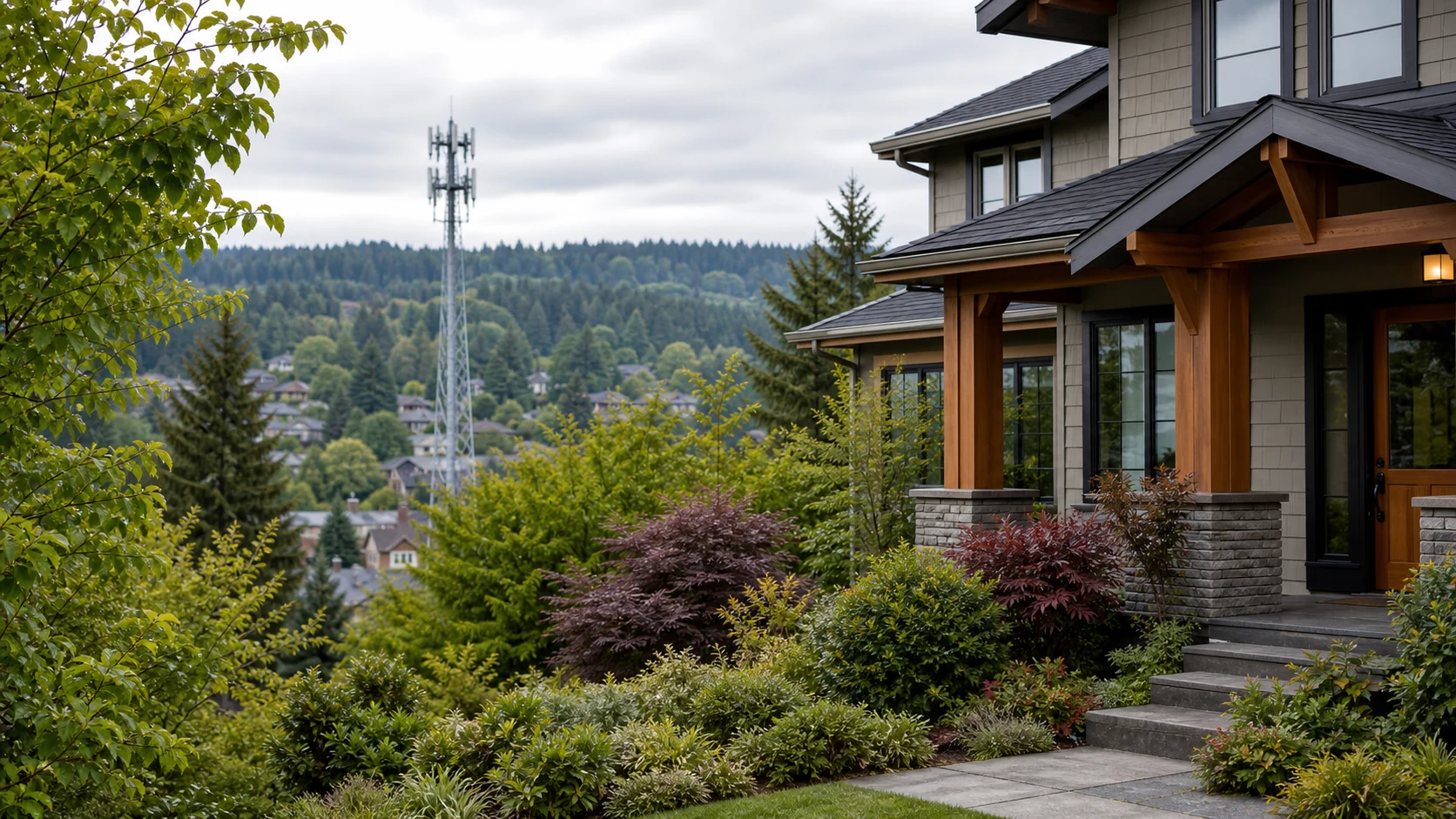
Buying a home is already a large decision. When a cell tower, rooftop antenna, small cell, smart meter, or other RF source is part of the picture, some buyers want clearer information before they make an offer, remove contingencies, or decide whether the home is a good fit.
That is reasonable due diligence.
A visible tower does not automatically mean a home has unusually high RF readings. It also does not mean the concern should be dismissed. The practical question is simple: what are the measurable conditions at the property, and how do they compare with the buyer’s current environment?
This article is written for buyers anywhere who want a calm, measurement-first way to think about the decision. EMF Guru also works with buyers in the greater Portland area who want on-site measurements before purchasing a home.
A visible tower is a due diligence question.
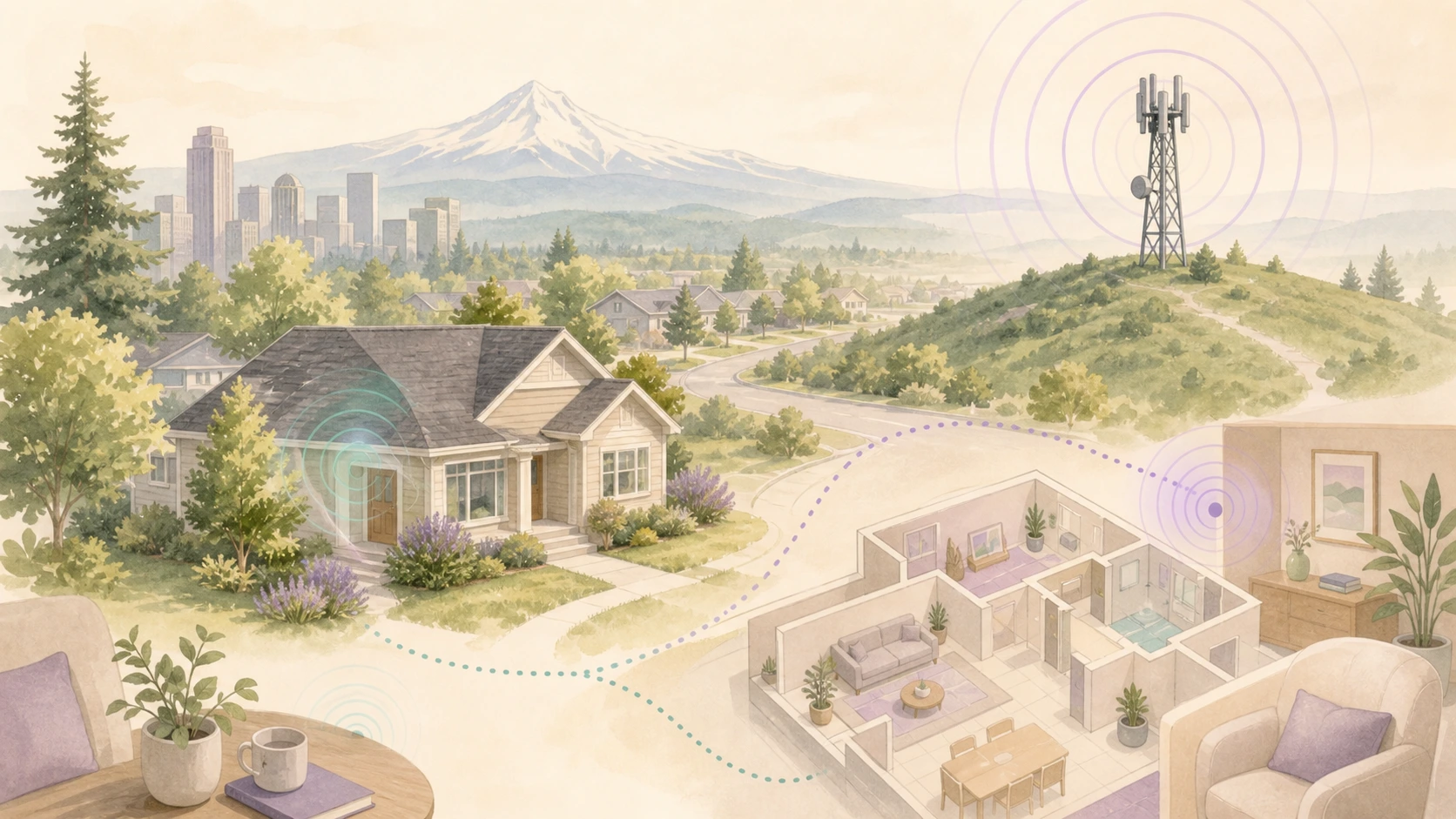
One common scenario looks like this: a buyer finds a home that otherwise looks promising, but they can see a cell tower from the property or from a nearby street. The buyer, their family, or their realtor wants to know whether that tower meaningfully changes the home’s EMF profile.
The right response is not panic. It is measurement.
RF exposure from wireless infrastructure depends on more than visibility. Distance matters, but so do antenna direction, elevation, terrain, building materials, nearby small cells, indoor wireless equipment, and the rooms where people spend time.
The source you can see may not be the strongest source at the bed, desk, couch, or nursery. Sometimes the larger contributors are inside the home: Wi-Fi routers, mesh nodes, smart devices, phones, wireless security systems, or a smart meter mounted near a long-use room.
That is why a useful assessment looks at the whole environment rather than only the object that caught attention.
Start with a baseline at your current home.
For many buyers, the most useful first step is a current-home baseline.
That means measuring the home where the buyer already lives before measuring the prospective home. This gives the buyer a familiar comparison point. Instead of looking at a number in isolation, they can ask: is the home I want to buy higher, lower, or similar to the place I already live?
A current-home baseline can include:
- RF readings, magnetic fields, electric fields, and dirty electricity checks where relevant
- Measurements in bedrooms, offices, living areas, and exterior-facing walls
- Magnetic field readings near beds, panels, appliances, and wiring paths
- Notes about Wi-Fi, smart meters, nearby transmitters, and indoor devices
This does not make the decision for the buyer. It gives context. A number that feels abstract becomes more useful when compared with a known environment.
Then measure the home you want to buy.
After the baseline, the prospective-home assessment can focus on the property under consideration.
For a buyer concerned about a cell tower, small cell, smart meter, power line, or other EMF source, a professional assessment may look at:
- RF readings outside the home, including the side facing the visible source
- RF readings inside key rooms, especially bedrooms and work areas
- Differences between floors, walls, windows, and exterior exposures
- Whether the strongest RF source appears to be outside the home, inside the home, or at the utility meter
- Smart meter location and any shared meter bank
- Magnetic fields near panels, service lines, appliances, and wiring paths
- Electric fields around long-use areas
- Dirty electricity when the situation calls for it
The goal is not to create a pass-fail label. The goal is to give the buyer practical information while there is still time to make a decision.
What can an EMF assessment tell you?
A pre-purchase EMF assessment can help answer practical questions:
- Are RF readings higher near the side of the home facing the tower or small cell?
- Are bedrooms materially different from the rest of the home?
- Is the strongest measurable source outside the home, inside the home, or near the utility meter?
- Are there magnetic field concerns near a bed, panel, service drop, or appliance?
- Are there simple changes that could improve the home if the buyer purchases it?
- How does the prospective home compare with the buyer’s current home baseline?
This can be useful for buyers in any market. It is especially helpful in areas where housing stock, terrain, lot size, utility layout, and wireless infrastructure vary from neighborhood to neighborhood.
In the Portland area, that might mean comparing an inner Portland home with nearby small wireless facilities, a hillside property in Happy Valley, a denser neighborhood in Beaverton, a larger lot in West Linn, a townhome in Clackamas, or a property across the river in Vancouver or Camas.
Know what an EMF assessment cannot tell you.
An EMF assessment is environmental due diligence. It is not a medical opinion, legal opinion, appraisal, or home inspection.
It does not diagnose symptoms. It does not predict health outcomes. It does not decide whether a buyer should purchase the home. It does not replace inspection, appraisal, title review, financing review, or advice from qualified legal, real estate, medical, or construction professionals.
What it can do is clarify measurable conditions so the buyer and realtor are not working from guesswork alone.
That boundary matters. The most useful EMF assessment is practical and specific: here is what was measured, here is where it was measured, here is what seemed to be contributing, and here are reasonable next steps if the buyer chooses to proceed.
What does this look like in the Portland area?
EMF Guru provides on-site EMF measurements in Portland, Oregon and surrounding communities. Local buyers often compare very different property types across a short distance, which is one reason measurement can be more useful than assumptions.
Common Portland-area factors include:
- Visible macro towers on nearby ridgelines, commercial properties, or utility sites
- Small wireless facilities on poles or street infrastructure
- Smart meters mounted near bedrooms, offices, or long-use rooms
- Shared meter banks in multifamily or attached housing
- Overhead or underground utility service routes
- Electrical panels near bedrooms, offices, or living spaces
- Indoor Wi-Fi and mesh networks installed for larger homes
- Home offices with multiple wireless devices
None of these automatically makes a home unsuitable. They are simply items worth checking when a buyer has EMF concerns.
Examples of Portland communities where EMF Guru provides on-site EMF consultations include Montavilla, Sellwood-Moreland, Woodstock, Laurelhurst, Richmond, Sunnyside, Irvington, Alberta, St. Johns, Kenton, Multnomah Village, Hillsdale, Lents, Eastmoreland, and West Albina.
Use this practical buyer checklist.
If you are considering a home near a cell tower or other RF source, use this sequence.
1. Note the visible concern.
Take photos or notes of the tower, small cell, meter bank, power lines, or other infrastructure that prompted the question. Do not assume visibility equals exposure, but do document the concern.
2. Measure your current home.
If possible, start with a baseline where you live now. This gives the prospective-home readings useful context.
3. Measure the prospective home.
Focus on the rooms that matter most: bedrooms, home offices, nurseries, living areas, and outdoor spaces where the household expects to spend time.
4. Compare instead of guessing.
Ask whether the home is higher, lower, or similar to your current environment in the areas that matter to you.
5. Separate simple fixes from fixed conditions.
Some sources can be changed after purchase, such as router placement or smart-device habits. Others, such as a neighboring tower location, nearby small cell, or shared meter bank, may be less controllable.
6. Keep the decision in context.
Use EMF information alongside inspection findings, commute, budget, school needs, neighborhood fit, and the other realities of buying a home.
The bottom line for buyers.
If you are buying a home near a visible cell tower, small cell, smart meter, or other RF source, you do not need fear-based advice. You need measured information.
A current-home baseline followed by a prospective-home assessment can help you understand the difference between the place you live now and the place you are considering. That makes the decision more concrete, especially when visible infrastructure has raised a reasonable question.
Measurement does not make the choice for you. It gives you better information while the choice is still yours to make.