
Professional EMF measurements rarely depend on one meter. RF signals, 5G millimeter wave signals, AC electric fields, AC magnetic fields, dirty electricity, body voltage, wiring issues, and static magnetic anomalies are different measurement problems. A good consultation uses the tool that fits the question, then interprets the reading in context.
For homeowners, though, it is reasonable to ask where to start. A basic meter can be useful for learning patterns, comparing locations, and deciding when a deeper assessment is worth it. The key is to understand what a beginner meter can do and what it cannot do.
Start with the question, not the meter.
Before buying anything, name the concern. Are you trying to compare Wi-Fi levels in rooms? Check whether a bed is near a magnetic-field source? See whether cords near a desk create high electric fields? Understand a smart meter, solar inverter, breaker panel, or home office setup? Each question points toward a different tool.
A meter that is useful for one category may be weak for another. This is the most common beginner mistake. People buy a general meter, see changing numbers, and assume they are seeing the whole EMF picture. In reality, the meter may be emphasizing one field type while missing another.
Where the TriField TF2 fits.
For a simple first meter, the TriField TF2 is still the easiest place to start. It puts magnetic, electric, and RF modes in one handheld tool, so a homeowner can compare rooms, notice obvious changes, and learn how distance affects readings without buying a full professional kit.
The best use of the TF2 is comparison. Instead of treating one number as a final verdict, compare the bed area with the hallway, the desk with the room center, the router on and off, the charger plugged in and unplugged, or the laptop on battery versus on its power supply. Patterns are more useful than panic.
That convenience is also why the TF2 should be treated as a screening meter, not the final word. When it flags a concern, EMF Guru follows up with dedicated instruments that are more sensitive, more category-specific, and better suited for professional reporting.
What beginner meters often miss.
Beginner meters have limitations. They may not handle all RF frequencies equally. They may not capture short bursts well. They may not separate overlapping sources. They may not evaluate dirty electricity on wiring. They may not provide the frequency detail needed to distinguish a Wi-Fi signal from another transmitter. They may be directional or position-sensitive in ways that are easy to misunderstand.
Some meters combine RF, electric, and magnetic modes in one device, but that does not make them professional instruments for every category. A “three-axis” feature, frequency range, sampling behavior, calibration, display speed, and sensor design all affect what the meter is actually telling you.
How to use a basic meter responsibly.
- Read the manual. Know which mode you are using and what unit is displayed.
- Measure where people spend time. Beds, desks, and favorite seats matter more than random corners.
- Compare before and after. Move a device, unplug a charger, or change router placement, then test again.
- Keep notes. Record location, device state, time, and meter mode so results are not just impressions.
- Avoid body blocking. Your body, hand position, and meter orientation can influence some readings.
- Do not diagnose health. A meter can show environmental patterns; it cannot explain symptoms by itself.
Why EMF Guru uses a professional meter kit.
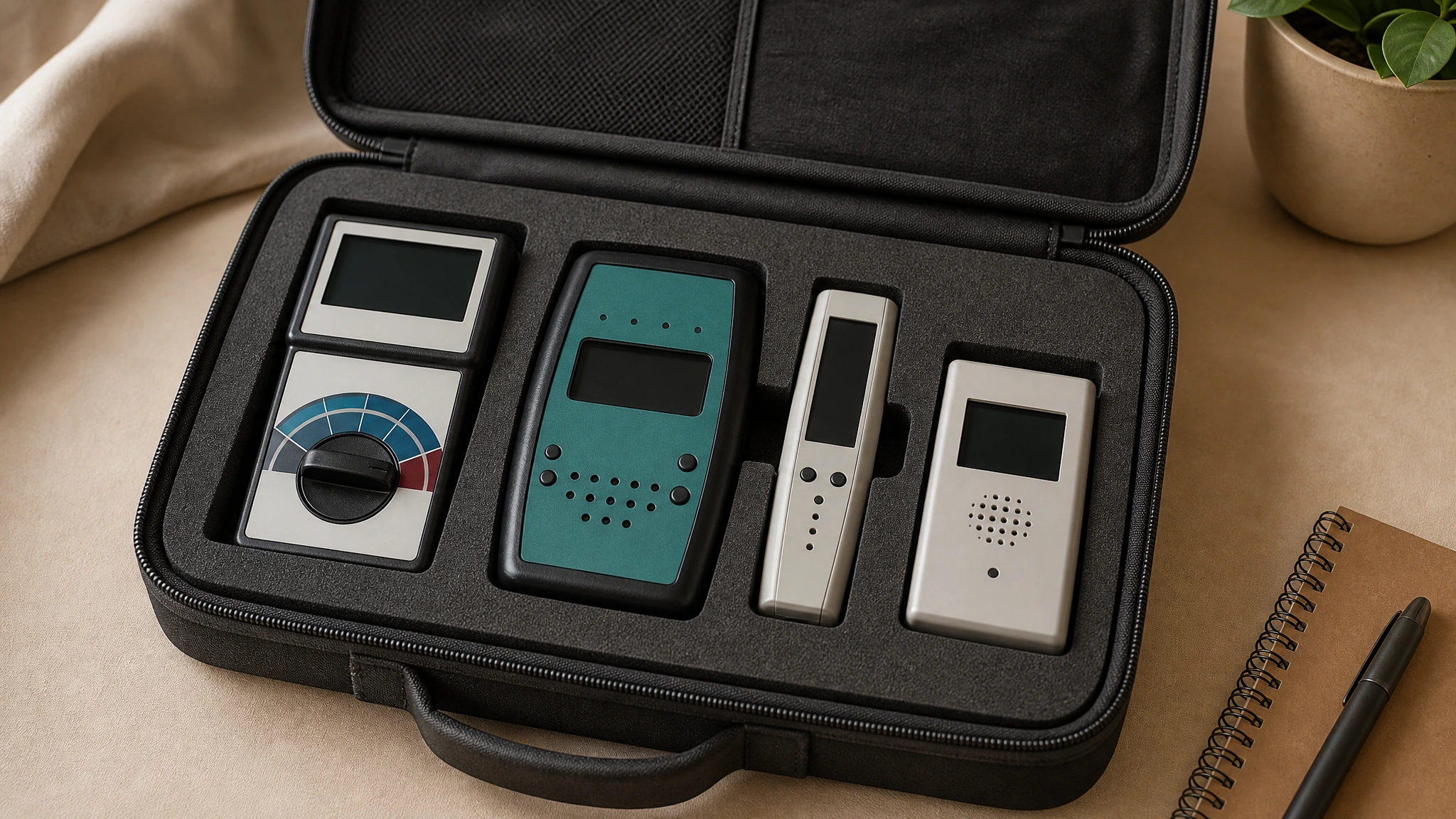
The TriField TF2 is useful because it gives one simple starting point, but EMF Guru does not rely on one consumer meter for professional assessment. We use an extensive collection of dedicated meters and diagnostic tools worth thousands of dollars, because RF, electric fields, magnetic fields, dirty electricity, body voltage, wiring errors, and grounding problems each require different instruments.
- RF below 8 GHz: Safe Living Technologies Safe and Sound Pro II for sensitive RF readings of Wi-Fi, Bluetooth, smart meters, cordless phones, and cell signals.
- 5G millimeter wave RF: Safe Living Technologies Safe and Sound Pro mmWave with stub antenna for 20–40 GHz full 5G range detection.
- AC electric fields: Gigahertz Solutions ME 3951A as the primary electric-field meter, with filters for power-frequency and higher-frequency harmonics, plus the Gigahertz Solutions ME 3830B as a quick-screening and backup meter.
- AC magnetic fields: AlphaLab UHS2 3-axis milligauss meter for sensitive magnetic-field mapping from wiring, appliances, panels, transformers, and power lines.
- Dirty electricity and line EMI: AlphaLab Line EMI Meter / TriField EM100 for outlet-level millivolt peak-to-peak readings, supported by a Retekess V117 AM/SW radio for audible EMI screening.
- Body voltage: Etekcity MSR-A600 multimeter with grounding rod and leads for sleep-area body-voltage testing.
- Net current and wiring diagnostics: Bside ACM91 True RMS clamp meter for current on conductors, pipes, and grounding paths, plus a receptacle tester for outlet wiring faults.
- DC magnetic fields: a traditional compass for first-pass detection of magnetized beds, springs, steel furniture, rebar, and other static magnetic anomalies.
That broader kit matters because a “high” reading is only useful when it is tied to the right field type, the right source hypothesis, and the right measurement method. A simple meter can help decide when to look closer; dedicated tools help explain what is actually happening and which change is worth making.
Meter choice by common goal.
- Learning general patterns: a basic multi-function meter can be a reasonable introduction.
- Router and wireless placement: an RF-capable meter can help compare locations, but frequency limitations matter.
- Bedroom cord and wiring checks: electric-field and body-voltage methods may be more useful than RF alone.
- Panel, transformer, or wiring concerns: magnetic-field mapping requires attention to location, load, and source direction.
- Solar, dimmers, or circuit noise: dirty-electricity tools or electrical review may be needed.
A sensible buying approach.
If you are curious and want to learn, a basic meter can be worthwhile as long as expectations are realistic. Use it to compare, not to certify. Treat it as a way to identify patterns and questions. If the meter shows a clear pattern in a high-use area, or if readings do not make sense, professional testing may be a better next step than buying more gadgets.
If the concern is specific, expensive, or emotionally loaded, consider measuring professionally before buying mitigation products. A consultation can often save money by showing which field type is present, where the source is, and which changes are likely to matter.
When professional measurement helps.
Professional testing helps when the concern involves sleeping areas, nurseries, smart meters, panels, shared walls, solar equipment, apartments, nearby infrastructure, or overlapping sources. It is also useful when a homeowner has already made changes but wants to verify whether they helped.
For more on how professional testing differs from assumptions, read EMF Testing vs Guessing. For a service overview, see What Happens During an EMF Consultation?.
Beginner meter mistakes to avoid.
One common mistake is chasing peaks without recording conditions. A brief RF burst may look dramatic, but it may not represent the normal level at a bed or desk. Another mistake is comparing numbers from different modes as if they use the same scale. RF, electric-field, and magnetic-field readings are not interchangeable.
It is also easy to change the reading by changing how the meter is held. Keep the meter position consistent, step back when the manual recommends it, and repeat measurements before drawing conclusions.
When not to buy another meter.
If a basic meter has already shown a confusing pattern, buying a second general-purpose meter may not help. The better next step may be a specific measurement method or a professional assessment. Specialized questions require specialized tools and interpretation.
For example, a smart meter concern may require RF measurements that account for bursts and direction. A bed-near-panel concern may require magnetic-field mapping. A cord-near-bed concern may require electric-field or body-voltage evaluation. A solar-inverter concern may require circuit-level review.
A good first-meter mindset.
Use a beginner meter to learn your home, not to certify safety. It can show which locations differ, which devices create obvious changes, and which questions deserve better testing. If it helps you make one practical, verified improvement, it has done useful work.
What readings to write down.
Good notes make a beginner meter far more useful. Record the room, exact location, meter mode, device state, distance from the likely source, and whether the reading was steady or intermittent. A photo of the setup can help you repeat the same measurement later.
For RF, note whether phones, routers, mesh nodes, Bluetooth devices, and smart equipment were active. For electric or magnetic fields, note what was plugged in, what appliances were running, and whether you were measuring near a wall, cord, panel, or device.
Why professional reports use context.
A professional reading is not just a number. It is a number tied to a field type, instrument, location, source hypothesis, room use, and practical recommendation. That context is what turns measurement into a decision.
If a beginner meter helps you identify a repeatable pattern, that information can make a professional visit more efficient. It gives the consultant a starting point while still leaving room for better instruments and interpretation.
Bottom line for a first meter.
If you want to explore your home, start with a practical screening mindset. A beginner meter can help you notice patterns, compare rooms, and test simple changes. It should not be treated as a complete lab instrument or a medical tool.
The best outcome is not a perfect number. The best outcome is a clearer decision: move the source, leave it alone, wire a fixed device, ask an electrician, or bring in professional measurement for a question the beginner meter cannot answer well.
If budget is limited, spend first on understanding the question. A modest meter, careful notes, and one verified change may be enough for a simple concern. For complex situations, putting that budget toward professional testing may be more useful than stacking several consumer meters with overlapping limitations.
In short, buy for the question you can define, not for every worry a product page can create. Keep the process calm, written down, and repeatable.
Note: EMF Guru provides education and environmental measurement services, not medical diagnosis or treatment. If you have health concerns, work with a qualified healthcare professional. Measurements can help clarify environmental sources and practical exposure-reduction options.