
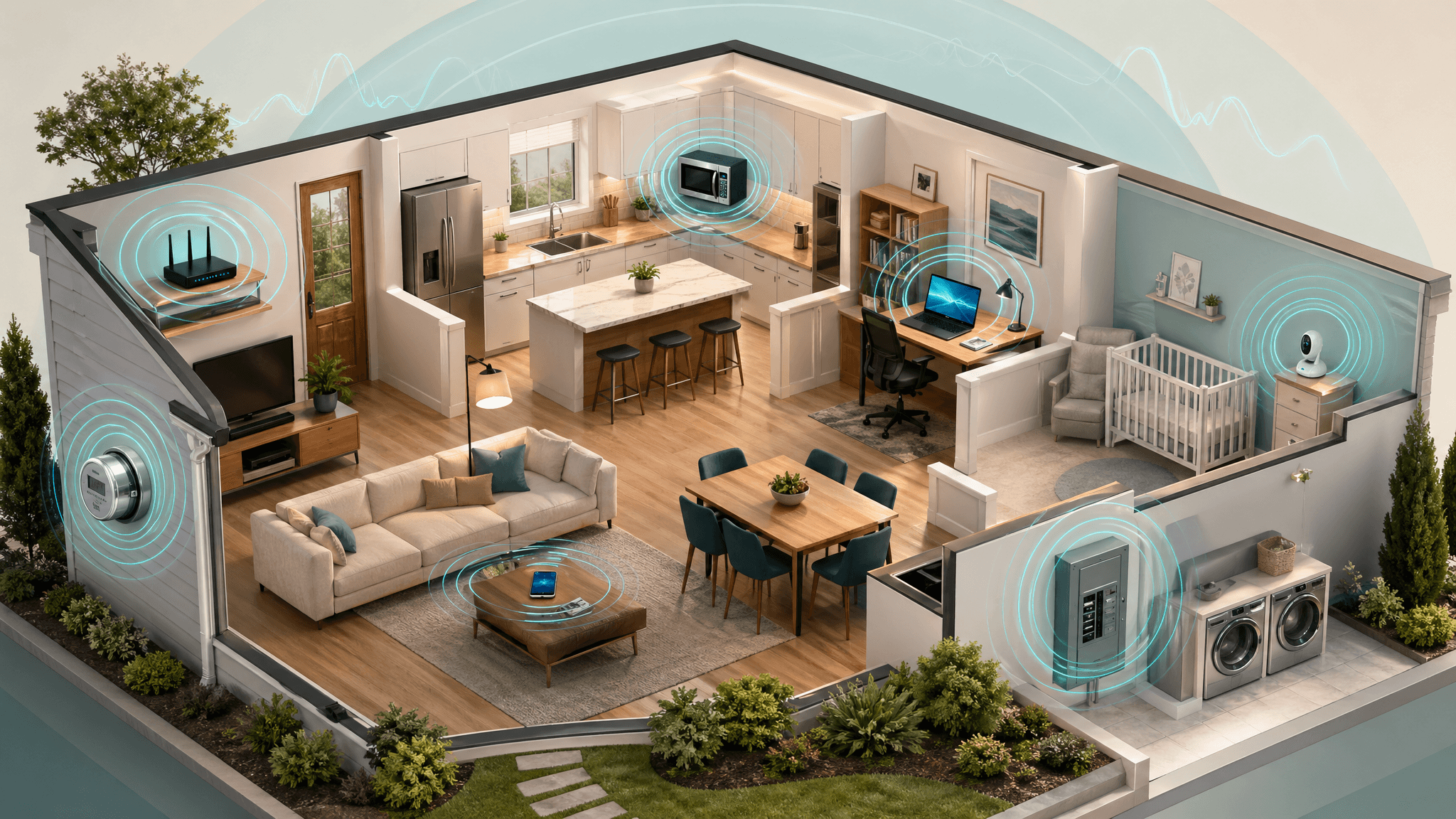
Modern homes contain more electronics than ever, but not every device deserves the same level of attention. A practical EMF review starts by identifying likely sources, then measuring the places where people spend the most time.
The most useful question is not “What in this house creates EMF?” Almost everything electrical does. A better question is “Which sources are close, consistent, avoidable, or unusually high in the areas where people sleep, work, recover, or spend long stretches of time?”
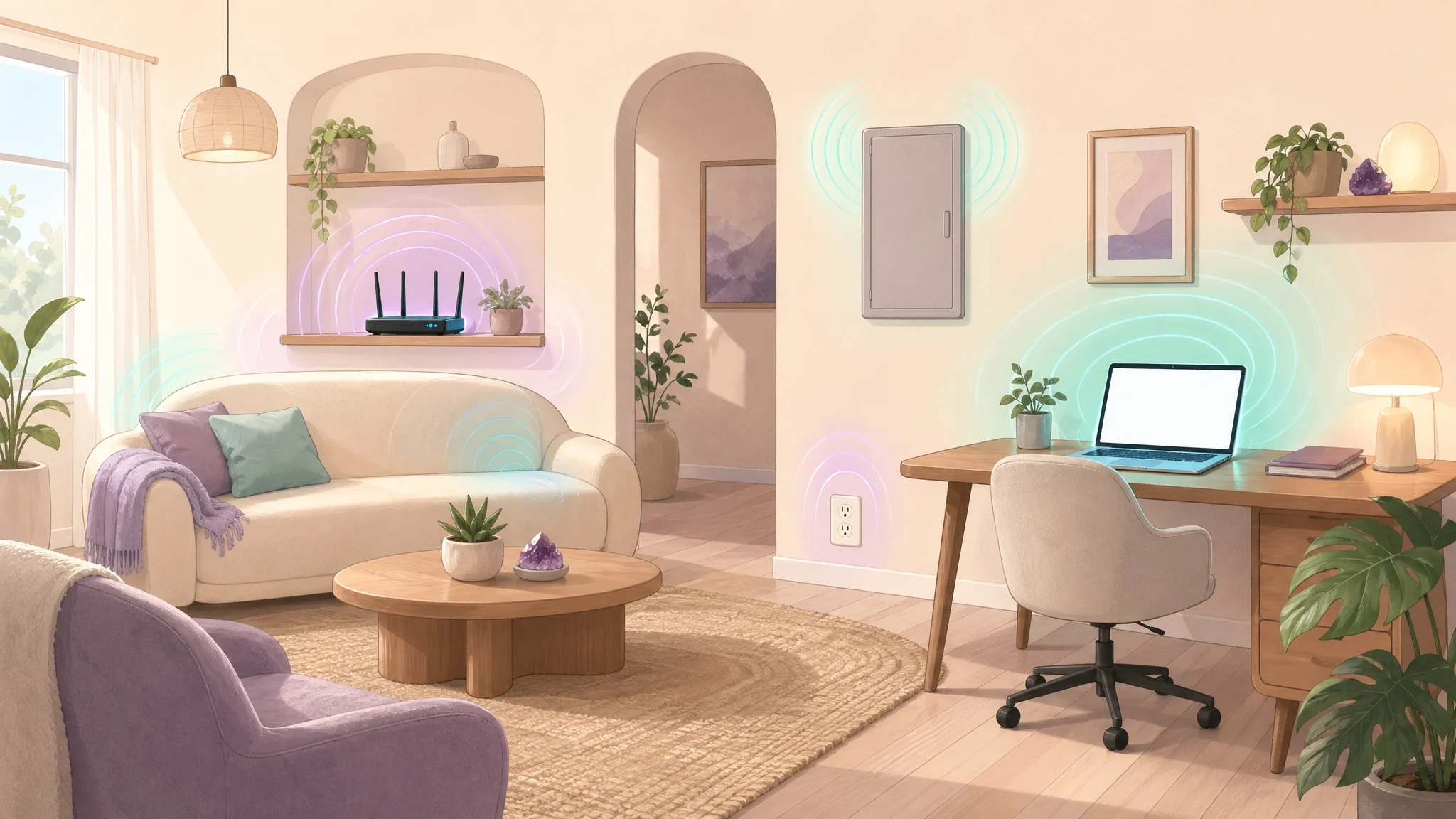
Wireless sources.
Wireless devices are the sources most people notice first because they are visible and familiar. Wi-Fi routers, mesh nodes, phones, tablets, Bluetooth speakers, wireless headphones, smart TVs, game consoles, smart appliances, baby monitors, wireless cameras, smart thermostats, smart watches, and smart meters can all produce RF signals.
That does not mean every wireless device is equally important. A router across the house may be less relevant than a phone transmitting on a nightstand. A mesh node in a bedroom may matter more than a device in a garage. A baby monitor that transmits all night near a crib deserves more attention than a tablet used briefly across the room.
Wireless review usually begins with placement and use patterns. Which devices are always on? Which ones are close to beds or workstations? Which fixed devices could use Ethernet instead? Which wireless features are left on even when no one needs them?
Electrical and wiring sources.
Wiring is less visible, but it can be important. Wall wiring, lamp cords, extension cords, power strips, chargers, ungrounded outlets, electrical panels, meter bases, and service lines can contribute electric or magnetic fields depending on the situation. Sometimes the issue is not the device in the room but wiring behind a wall, equipment in an adjacent room, or a condition on a circuit.
Bedrooms often reveal these patterns because beds are stationary and people spend hours in the same location. A power strip under the bed, a lamp cord behind the pillow, or a panel on the opposite side of the wall can be more relevant than a device used briefly during the day.
For wiring-related concerns, measurement is especially useful because the source may not be obvious. Turning off a breaker, unplugging a device, changing a load, or checking the other side of a wall can help narrow the source before anyone spends money on mitigation.
Lighting, solar, and electronics.
Lighting and power electronics can contribute to higher-frequency noise on wiring in some homes. Dimmers, LED drivers, compact power supplies, chargers, variable-speed motors, solar inverters, battery systems, and some appliances may create circuit-level conditions worth checking. These situations vary widely, so broad assumptions are not helpful.
A noisy device in a low-use area may not be a priority. A device that affects circuits serving bedrooms or a home office may be more relevant. The practical approach is to isolate devices, compare circuits, and confirm whether a change actually improves the measured condition.
Room-by-room examples.
- Bedroom: phones, chargers, lamps, power strips, adjustable beds, baby monitors, smart speakers, nearby smart meters, and wiring behind the headboard wall.
- Home office: Wi-Fi routers, laptops on chargers, monitors, docking stations, power strips, printers, Bluetooth accessories, and nearby electrical panels.
- Living room: smart TVs, streaming boxes, game consoles, soundbars, wireless speakers, mesh nodes, and media cabinets full of power supplies.
- Kitchen and laundry: motors, induction equipment, microwave ovens, smart appliances, lighting controls, and appliance circuits.
- Exterior or utility areas: service drops, meter bases, transformers, solar equipment, communication lines, and neighboring sources.
Start with use patterns.
EMF priority is a combination of source strength, distance, duration, and practical control. A strong source far away may be less important than a moderate source next to a bed. A device that transmits only during brief use may be less important than one that runs all night. A source that can be moved or turned off easily may be a better first target than one that requires major electrical work.
Before buying products, make a simple map of high-use locations: bed, desk, favorite chair, nursery, and exercise or therapy areas. Then identify nearby wireless devices, cords, panels, meters, appliances, and shared walls. That map gives testing a purpose.
When testing is worth it.
Professional testing is useful when a source is hidden, a room has several possible contributors, or prior changes did not produce the expected improvement. It is also useful before expensive mitigation, because product-first decisions can miss the actual issue.
For a deeper measurement overview, read The Four Types of EMF We Measure in Homes. If you want help reviewing a specific property, see EMF Guru consulting.
How to decide what deserves attention first.
Use a simple priority filter: close, constant, controllable, and connected to a high-use area. A source that is close to a pillow, runs all night, and can be moved easily is a better first step than a distant source that would require major work and has not been measured.
This filter also keeps the review from becoming overwhelming. A modern home can contain dozens of electrical and wireless sources. The practical goal is to find the few that are most relevant to daily life.
Note: EMF Guru provides education and environmental measurement services, not medical diagnosis or treatment. If you have health concerns, work with a qualified healthcare professional. Measurements can help clarify environmental sources and practical exposure-reduction options.